The 3 scenarios below are drawn from real-world manufacturing environments—each presenting a unique installation challenge along with a proven field solution.
1. Ultraminiature Fiber Optic Probes for SMT Component Detection
Modern PCB assemblies are densely packed, leaving gaps between chip leads as narrow as a few millimeters. Conventional photoelectric sensors—whether rectangular or cylindrical M12/M18 models—are far too bulky to position close to the target inspection area prior to soldering.
Metallic tube fiber optic probes with sensing tip diameters ranging from 0.5mm to 1mm provide access where conventional sensors cannot reach. Technicians route these thin probes deep inside the tight clearance of the pick-and-place head to confirm chip alignment immediately before soldering, significantly reducing pin misalignment defects on the board.
2. Inspecting Aluminum Caps on High-Speed Bottling Lines
Glass bottles travel continuously along conveyor lines at speeds of hundreds of units per minute. Missing or misaligned caps must be rejected instantly, but clearance above and alongside the conveyor is severely constrained, creating collision risks with machine mechanisms if bulky equipment is installed.
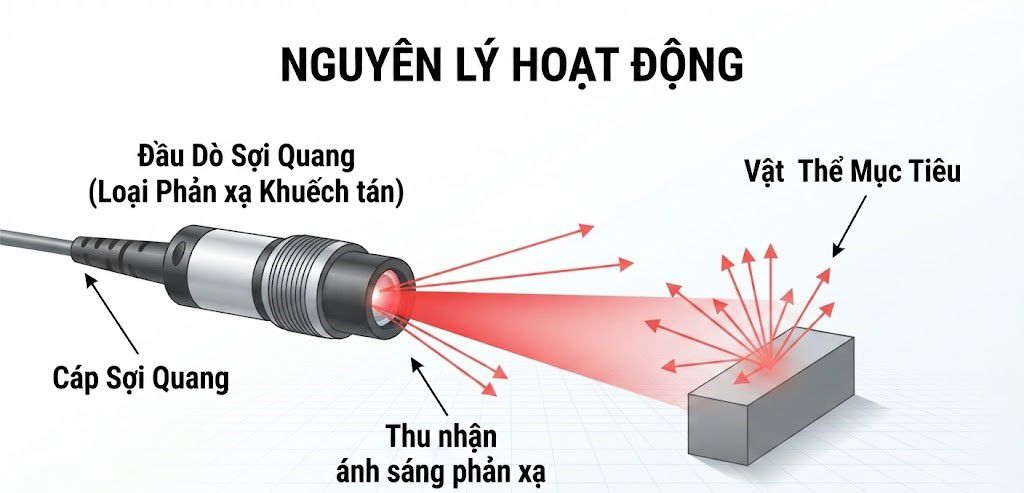
A single diffuse-reflective fiber optic probe mounted directly above the conveyor effectively solves this challenge. Light emits onto the flat aluminum cap surface and reflects back to the fiber amplifier. A missing or tilted cap causes a sudden drop in reflected light intensity, triggering the controller to activate the rejection mechanism immediately without slowing down line throughput.
3. Monitoring Metal Blanks Inside Stamping Dies in Harsh Environments
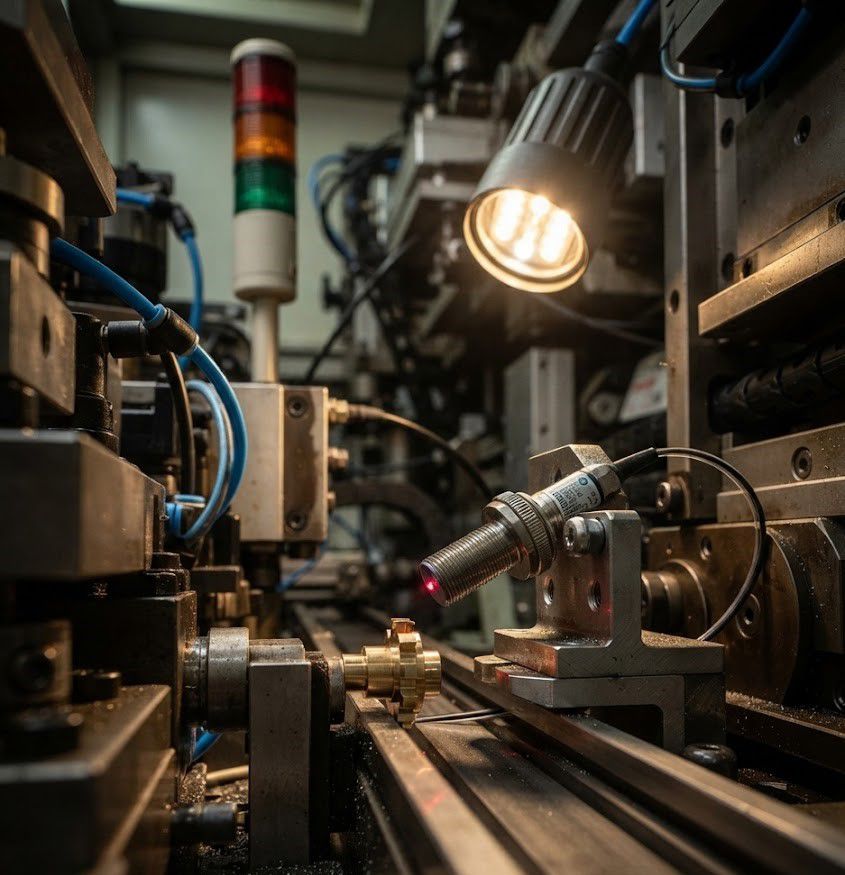
Mechanical stamping dies accumulate heavy grease, experience high ambient temperatures, and endure continuous vibration throughout production shifts. Standard electronic sensors installed close to this working area frequently suffer electrical failures after short operating periods.
The solution involves isolating electronic components entirely from the harsh environment. The optical amplifier unit is installed inside an external control cabinet, extending only a stainless steel armored, heat-resistant fiber optic cable directly into the die cavity. The probe scans the steel blank surface directly to confirm accurate placement before the stamping stroke occurs, preventing costly die damage caused by misaligned blanks.
Why Diffuse-Reflective Sensing Suits Restricted Mounting Locations
While the three scenarios span different industries and environmental conditions, they share a common constraint: insufficient space for traditional opposed-mode emitter-receiver pairs. Diffuse-reflective fiber probes resolve this bottleneck by integrating the light emitter and receiver into a single sensing head, requiring access from only one side of the target object.
The flexible, small-diameter structure of optical fibers allows routing through complex pathways where rigid electrical cables or sensor bodies cannot pass. This flexibility provides a decisive advantage in applications such as SMT machines and stamping dies, where physical clearance is measured in millimeters.
Further reading:
Optimal Wiring and Configuration of Optical Amplifiers for Production Lines
Key Criteria for Selecting 24V Photoelectric Sensors in Automation Systems
How Fiber Optic Probe Construction Determines Application Suitability
Sensing tip diameter, outer sleeving material, and fiber cable length are three primary parameters that define environmental suitability. Sub-millimeter sensing tips target narrow clearances on PCB assemblies. Heat-resistant stainless steel armor suits oily, high-temperature stamping dies. Flat-profile fixed probes offer ideal stability for continuous monitoring on high-speed conveyors.
Selecting the correct probe type for each installation location is as critical as choosing the sensing principle itself; an oversized or excessively rigid probe can cause a diffuse-reflective implementation to fail during initial mounting.
![[EMIN x Fluke] Seminar Series on Maintenance of M&E Systems and Rooftop Solar Infrastructure](/s-cdn/76/7679a73b2ae9c53b53b710053f094a7418765531.jpg)