Why Are Standards Square Important?
In precision machining, even a minor deviation can affect assembly accuracy, fixture alignment, or the overall performance of machinery.
To control such deviations, squares are commonly used as reference tools throughout various stages of manufacturing, including machining, assembly, and the calibration of measuring instruments.
When choosing a precision square, engineers frequently encounter two well-known standards: DIN 875 and JIS B7526. These standards are widely applied to high-precision squares manufactured in Germany, Japan, and by many international manufacturers.
Understanding the differences between these standards helps companies select the right inspection tool for specific measurement requirements rather than relying solely on size or brand reputation.
What Is DIN 875?
DIN 875 is a German standard that specifies the technical requirements for engineer's squares used in mechanical inspection and measurement applications.
The standard focuses on squareness accuracy, geometric stability, and permissible error limits. As a result, users can evaluate the accuracy level of a square before using it for inspection or calibration tasks.
In industrial environments, DIN 875 is commonly found on precision steel squares, cast iron squares, and granite squares.
The standard typically defines four accuracy grades: Grade 00, Grade 0, Grade 1, and Grade 2.
Grade 00 and Grade 0 are primarily used in calibration laboratories and metrology facilities. Grade 1 is well suited for routine production inspections, while Grade 2 is generally used for basic inspection tasks with less demanding accuracy requirements.
What Is JIS B7526?
JIS B7526 is the Japanese Industrial Standard for angle gauge
Many well-known Japanese manufacturers, including Obishi, Niigata Seiki (SK), and Mitutoyo, apply this standard to their precision measuring products.
The objective of JIS B7526 is similar to that of DIN 875. The standard defines requirements for angular accuracy, material stability, and the ability to maintain measurement accuracy throughout service life.
By clearly specifying permissible tolerances, JIS B7526 enables users to select the appropriate accuracy grade for a given inspection task without investing in unnecessary levels of precision.
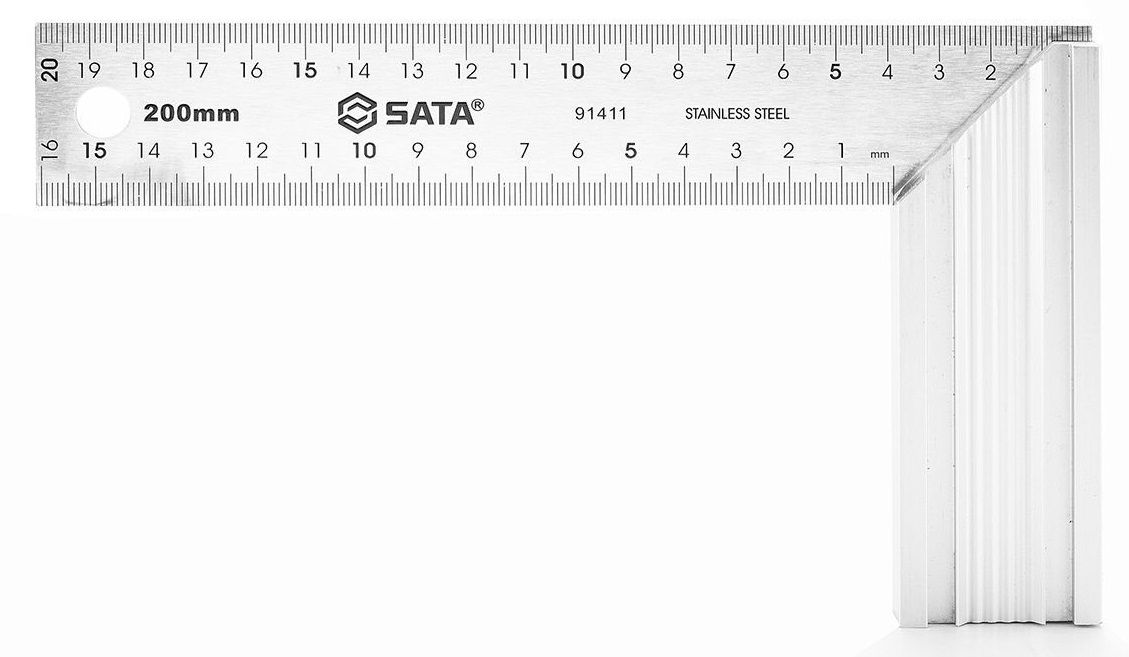
How Do DIN 875 and JIS B7526 Differ?
Fundamentally, both standards pursue the same goal: ensuring the accuracy and reliability of engineer's squares.
The primary difference lies in the fact that they were developed within different regional standardization systems. The choice between them often depends on the standards adopted by a company or the requirements specified by customers.
DIN 875 was developed in Germany and is widely used throughout Europe. In contrast, JIS B7526 is a Japanese standard and is commonly found on measuring instruments manufactured in Japan.
How Should the Accuracy Grade Be Selected?
The required accuracy grade should be determined according to the application. Using an excessively high accuracy grade for routine inspection tasks typically provides little practical benefit while increasing investment costs.
For general in-process inspections during manufacturing, Grade 1 is often sufficient. Quality control departments and metrology laboratories typically prefer Grade 0 to ensure reliable measurement results. Grade 00 is most beneficial for advanced calibration and high-level verification applications.
When selecting an protractor, companies should consider the technical requirements of the application, the required accuracy grade, and the standard system currently used within the facility. Choosing the right tool not only improves inspection quality but also helps maintain the overall stability and consistency of the manufacturing process.