In terms of equipment, this test cannot be performed using conventional orbital or reciprocating shakers. Instead, it requires a specialized end-over-end rotary shaker configuration.
Why Are Conventional Orbital Shakers Not Suitable for TCLP Testing?
The TCLP method is designed to simulate the process by which landfill leachate percolates through waste, carrying toxic constituents from solid waste into the groundwater environment. Orbital and reciprocating shakers generate horizontal oscillating movements, which can cause high-density solid particles to settle at the bottom of the extraction vessel, reducing contact efficiency between the solid and liquid phases. In contrast, TCVN 9239:2012 requires the equipment to rotate the extraction vessels end-over-end through 360 degrees around a central axis, ensuring continuous and thorough mixing of the solid phase and extraction fluid throughout the test cycle.
In addition to mechanical movement, reactions between the acidic extraction fluid (acetic acid or acetate buffer) and waste containing carbonates or sulfides may generate gas, increasing pressure inside the extraction vessels. The end-over-end rotating shaft, combined with specialized clamping fixtures, helps maintain a tight seal on the vessel caps, minimizing the risk of solvent leakage and analyte loss.
Four Key Technical Specifications for Configuring a TCLP Shaker
When preparing equipment budgets or reviewing technical specifications in laboratory shaker catalogs, technical personnel should carefully evaluate the equipment's suitability based on the following four practical operating criteria.
Stable Rotational Speed of 30 ± 2 rpm
TCVN 9239:2012 specifies a standard rotation speed of 30 ± 2 rpm, maintained continuously for 18 ± 2 hours. The shaker's drive system should use a high-torque geared motor or a microprocessor-controlled brushless motor to prevent speed fluctuations when operating under full load with dense sludge or metallurgical slag samples. The equipment should also be equipped with an electronic timer capable of operating for at least 24 hours to accurately control overnight extraction cycles.
Dynamic Load Capacity and Sample Capacity
A standard 2-liter extraction vessel containing 100 g of solid sample and 2 liters of extraction fluid has a total weight of approximately 2.5–3 kg, including the vessel and clamping assembly. With an eight-position configuration, the total rotating load can reach approximately 24 kg.
The machine frame must be constructed from thick powder-coated steel or stainless steel, with a low center of gravity and vibration-damping rubber feet to prevent excessive vibration or displacement during unattended 18-hour operating cycles.
Depending on the daily sample throughput, laboratories may consider a four-vessel configuration for internal factory monitoring or expand to 6–12 vessels for environmental monitoring centers.
Compatibility of Clamping Fixtures with Extraction Vessel Materials
Depending on the analytical parameters specified in QCVN 07:2025/BNNMT, the material of the vessels mounted on the shaker platform must be selected accordingly.
For heavy metal and semi-volatile organic compound analysis, laboratories typically use wide-mouth 2-liter HDPE or PP extraction vessels. For volatile organic compounds (VOCs), however, the standard requires a Zero-Headspace Extractor (ZHE) made of 316 stainless steel and equipped with a compression piston.
Since ZHE vessels are heavier and longer than conventional 2-liter plastic vessels, the shaker's clamping fixtures must feature adjustable screws or flexible positioning mechanisms to securely accommodate both vessel types.
Safety Features for Overnight Operation
Since the 18-hour extraction cycle is typically programmed to run overnight without continuous supervision, the equipment should incorporate an automatic motor overload protection mechanism.
In addition, a protective safety guard or an emergency stop sensor that activates when the rotating chamber is opened is essential to ensure operator safety.
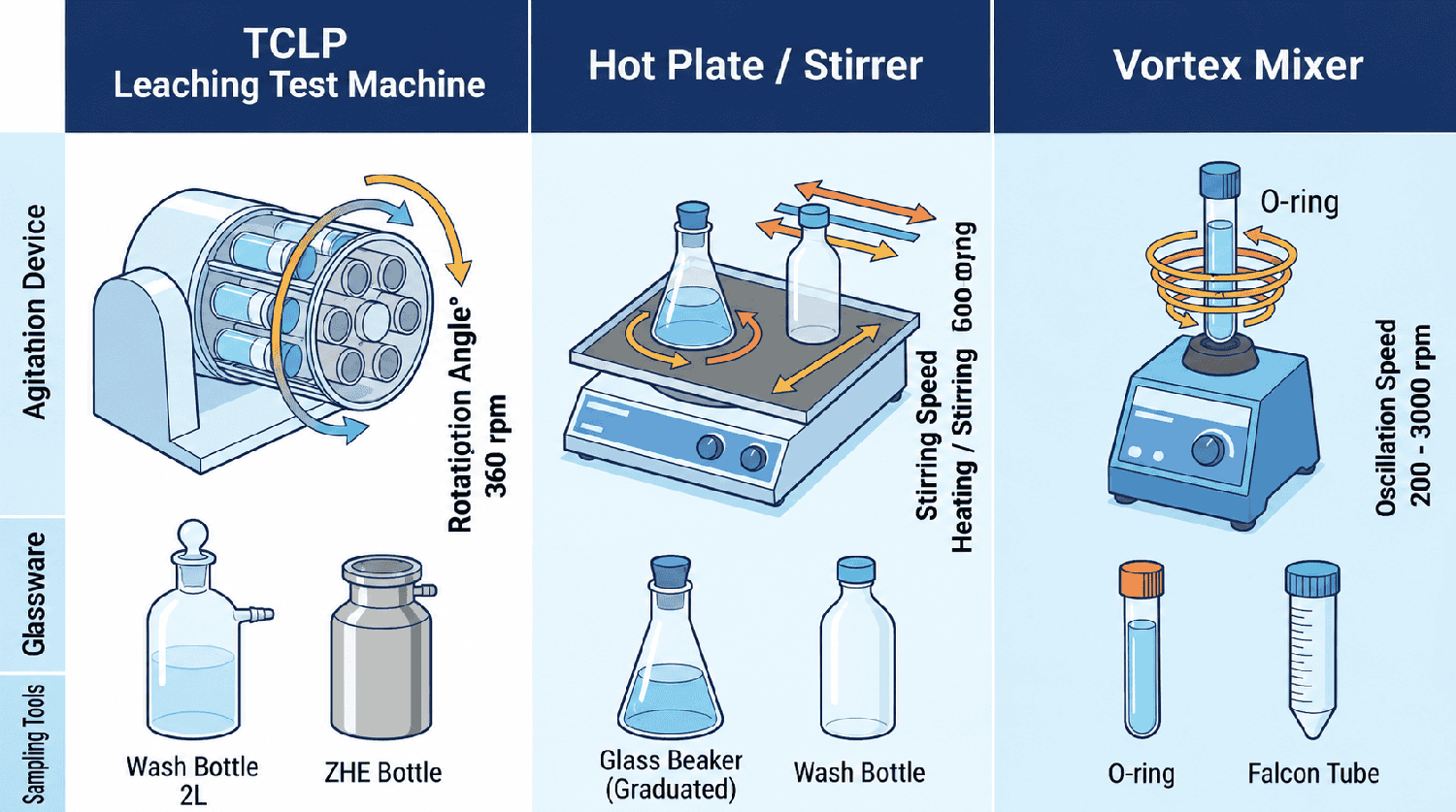
Distinguishing TCLP Shakers from Other Laboratory Sample Preparation Shakers
In environmental testing or residue analysis laboratories, selecting the appropriate equipment helps optimize investment costs and prevents equipment from being used for unsuitable applications.
Operating Guidelines and Periodic Checks in Accordance with ISO/IEC 17025
To maintain the reliability of TCLP testing during quality assessments, technicians should always arrange extraction vessels symmetrically around the rotation axis. If a batch contains an odd number of samples (for example, five samples on a six-position shaker), an additional counterweight vessel filled with water of equivalent mass must be installed to prevent uneven wear of the main shaft bearings.
For internal quality control, laboratories should use an optical tachometer to check the rotational speed under full-load conditions every 6–12 months, ensuring that the actual speed remains within the specified tolerance of 30 ± 2 rpm.
For VOC extraction batches using ZHE vessels, leak testing with an inert gas before operation is mandatory to identify and eliminate potential leakage through Viton/PTFE sealing rings.