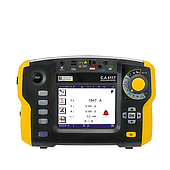
Technical reasons why surface resistance measurements are inaccurate.
Inaccurate surface resistance measurements often stem from a combination of factors. Most commonly, uneven contact between the electrode and the measurement surface, or the presence of dust, oil, or thin coatings that cause unstable electric field distribution, are contributing factors. Additionally, significant variations in ambient humidity can also cause substantial variations in surface resistance, especially with materials sensitive to RH.
High-range insulation resistance testers like the Chauvin Arnoux C.A 6547, with their ability to select appropriate measurement voltages and high stability, are commonly used to evaluate surface resistance, ESD flooring, or insulating materials in engineering and QA testing.
Another often overlooked cause is incorrect voltage measurement. According to ESD standards, measurements should use either 10V or 100V depending on the resistance range. If the device doesn't automatically select the appropriate voltage, or if the electrodes oxidize after prolonged use, the measurement results are likely to be inaccurate.
With specially designed devices like the TREK 152-1, stable electrodes, low noise, and the ability to automatically select 10V/100V significantly reduce measurement errors.
The effect of humidity and temperature on surface resistance.
Surface resistance changes directly with ambient humidity. When RH is high, the material tends to conduct electricity better; conversely, low RH causes resistance to increase sharply, making the material more insulating. If measurements are taken in an environment with uncontrolled humidity or constantly fluctuating environmental conditions, the results obtained are difficult to compare and easily deviate from the requirements of the ANSI/ESD STM11.11 standard.
Furthermore, measuring devices that lack the ability to record or compensate for temperature and humidity also increase the risk of inaccurate resistance readings. Models that integrate RH measurement and use a standard 5lb electrode, such as the Prostat PRS-801, ensure repeatability and accuracy even when environmental conditions change.
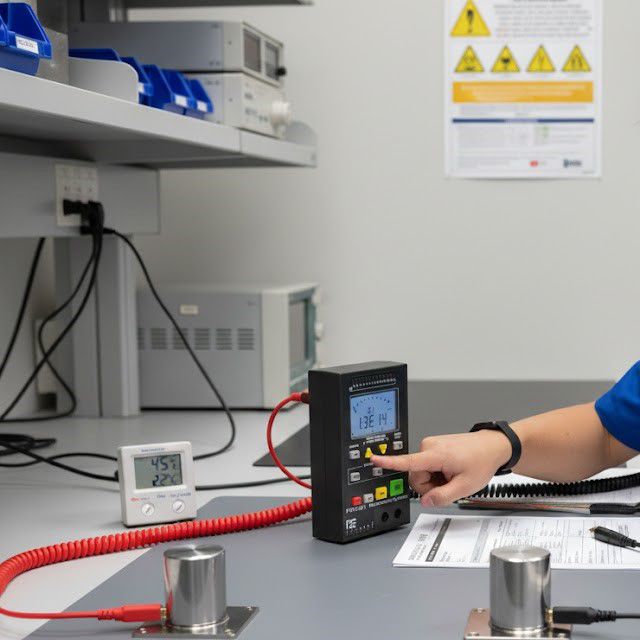
Errors due to measured voltage and measurement range not conforming to ESD standards.
Another common error stems from using equipment with limited measurement ranges or not adhering to the correct voltage measurement standards. Many inexpensive devices do not automatically switch between 10V and 100V, leading to significant errors when measuring high-resistance materials. In some EPA or ESD floor areas, if the measurement range is not wide enough, the device will not accurately reflect the actual insulation state of the material.
Measuring devices designed for QA/QC purposes, such as the KSD-300, typically have wide measurement ranges, fast display, and are suitable for testing ESD materials according to standards in electronics factories and cleanrooms.
Read more: When Should You Use a Surface Resistance Meter?
How to correct measurement errors using a standardized measurement procedure.
To minimize errors when measuring surface resistance, proper technical procedures must be followed. Before measurement, the material surface and electrode should be cleaned to remove dust and grease. Environmental conditions must be controlled, typically at 12% or 50% RH as required by standards. The electrode pressure must be correct, usually 2.5 lb or 5 lb depending on the measurement method.
In addition, measurements should be taken at multiple locations on the surface and the average value taken to increase reliability. Choosing a surface resistance meter with auto-ranging capability, standard electrodes, and good noise immunity will help ensure more stable measurement results, meeting the requirements for ESD control in SMT lines, clean rooms, and electronics factories.