
Logic Controllers
When a machine or process needs reliable decision-making without the complexity of a full-scale control system, logic controllers are often the practical choice. They are widely used to handle switching, sequencing, interlocking, timing, and small-to-medium automation tasks in panels, standalone machines, and building or utility systems.
On this page, you can explore logic controller solutions suited to different control architectures, I/O counts, and communication needs. The range includes compact DIN rail devices, expandable configurations, and supporting modules that help engineers build a control system that fits the application rather than oversizing it.
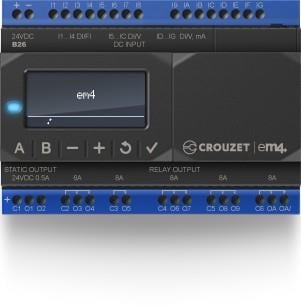
Where logic controllers fit in industrial automation
A logic controller is typically selected for applications where clear control logic is required: start/stop sequences, alarm handling, motor or actuator coordination, pump rotation, lighting control, small conveyor systems, or local machine automation. These devices sit between simple electromechanical relays and larger programmable automation platforms, giving users more flexibility while keeping installation and maintenance manageable.
Compared with dedicated control products such as a PID controller for closed-loop temperature or process regulation, logic controllers are better suited to handling multiple digital decisions and event-based logic. In projects where several functions must be combined in one compact controller, they can simplify panel design and reduce wiring complexity.
Common product types in this category
This category includes more than just base controllers. Alongside core units, there are also extension modules, communication accessories, and bundled kits that support commissioning or system expansion. That matters in practice, because many automation projects start with a basic I/O requirement and later need extra signals, networking, or easier programming access.
For example, some items in the range are compact controller bodies with fixed inputs and outputs, while others serve as digital expansion units for an existing platform. Accessories such as the Crouzet 88980171 Em4 connection lead are relevant when a controller must interface through Modbus-related connections, and kit-based options can be useful when software, cable, and power-related elements are needed together for deployment.
Representative options from SCHNEIDER and Crouzet
Two of the most visible manufacturers in this selection are SCHNEIDER and Crouzet. Each is relevant for compact automation projects, but the best fit depends on the required I/O structure, supply voltage, communication method, and whether the system may need to expand over time.
From SCHNEIDER, examples such as TM221CE16U, TM221ME16T, TM221CE24R, and TM221CE40U show the kind of compact logic control hardware often used in machine panels and Ethernet-connected control schemes. Within the Crouzet range, products such as the 88983902 Millenium Slim kit, the 88974163 expandable M3 unit, and several M3 extension modules illustrate a broader ecosystem approach where the controller can be adapted with additional modules or accessories.
How to choose the right logic controller
The first step is to define the control task clearly. Count the required inputs and outputs, identify whether signals are digital only or mixed analog/digital, and confirm the available supply voltage. Small differences here have a major effect on product selection, especially when matching field devices such as sensors, pushbuttons, contactors, solenoids, or alarm outputs.
It is also important to check output type, mounting method, and environmental suitability. Several products in this category are DIN rail mounted and intended for panel installation, with relay or transistor-style outputs depending on the model. If future changes are likely, an expandable architecture can be more practical than a fixed compact unit, particularly where more I/O or communication functions may be added later.
Communication is another key point. If the project needs Ethernet connectivity, remote access, or integration with supervisory systems, that requirement should be decided early. If the system instead needs straightforward local logic with minimal infrastructure, a simpler compact controller or slim logic relay style device may be sufficient.
Expansion, communication, and system flexibility
One of the strengths of this category is the ability to scale a control scheme without redesigning everything from scratch. Products such as the Crouzet 88970235, 88970233, and 88970231 extension modules are intended to extend digital control capacity in compatible systems. This approach is useful when an existing panel must add extra sensors, status signals, or actuated outputs while keeping the original controller platform in place.
There are also modules designed around Modbus interface support and accessory-based connectivity, which can help when controllers need to exchange data with HMIs, remote devices, or higher-level systems. In many retrofit projects, this flexibility is valuable because the control architecture must fit legacy equipment as well as newer communication expectations.
Typical applications and related controller categories
Logic controllers are commonly used in small machinery, building services, water handling skids, packaging equipment, door or access systems, and general-purpose sequencing tasks. Where the application focuses on a single process variable rather than discrete logic, another controller type may be more suitable. For example, dedicated level controllers are often considered for tank or reservoir monitoring, while specialized humidity controllers are more aligned with environmental control duties.
If your project requires a broader automation platform with deeper programming capability, you may also want to review programmable controllers. That comparison is often useful when deciding between a compact logic-focused device and a more extensive control system.
Practical selection points for buyers and engineers
For B2B purchasing, the right decision usually comes down to lifecycle fit rather than headline features alone. Check whether the controller matches your panel voltage standard, field wiring method, and maintenance expectations. A unit with the correct I/O count but the wrong output type or communication capability can create unnecessary redesign work later.
It is also worth considering whether you need a base controller, an expansion part, or a commissioning accessory. Some items in this category are not standalone control solutions by themselves, but they are essential for completing a functioning automation setup. Reading the product role carefully helps avoid ordering an accessory when the application actually requires a main logic controller, or vice versa.
Finding the right fit for your control architecture
This category is designed for users who need compact, dependable control hardware for real industrial tasks, whether that means a standalone controller, an expandable unit, or a supporting communication module. With options from SCHNEIDER and Crouzet, the range supports different panel designs, voltage standards, and integration needs without forcing every application into the same control format.
If you are comparing models, start with the logic requirement, I/O structure, power supply, and communication method, then narrow the choice based on expansion needs and installation constraints. That approach usually leads to a better long-term match than selecting only by size or nominal channel count.
Get exclusive volume discounts, bulk pricing updates, and new product alerts delivered directly to your inbox.
By subscribing, you agree to our Terms of Service and Privacy Policy.
Direct access to our certified experts