
Phase Angle Controllers
Accurate control of AC power is important in heating systems, motor-related processes, and other industrial loads where smooth output adjustment matters more than simple on/off switching. Phase Angle Controllers are used in these situations to regulate how power is delivered across each AC cycle, helping engineers manage process stability, startup behavior, and overall system response.
In industrial control panels, these devices are often selected when the application calls for finer power modulation or phase-related monitoring rather than basic relay action alone. This category brings together phase control solutions used in practical B2B environments, from solid-state power control to relay-based phase monitoring for three-phase systems.
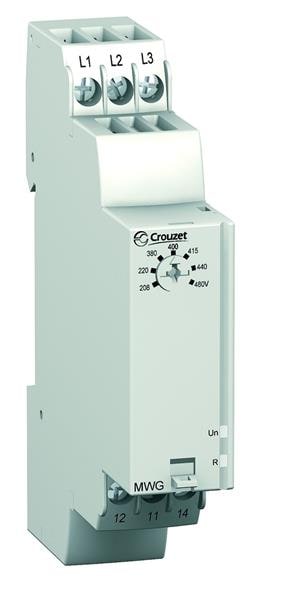
Where phase angle control is used
Phase angle control is commonly applied where the amount of AC power supplied to a load needs to be adjusted continuously or with good responsiveness. Typical use cases include electric heating, resistive loads, and process equipment that benefits from controlled power delivery rather than abrupt switching.
It can also be relevant in systems where phase sequence, phase loss, or voltage conditions must be monitored to protect equipment and maintain operating continuity. In broader automation projects, this type of control may be evaluated alongside a power controller when engineers compare different methods of managing electrical loads.
What to consider when selecting a controller
The right device depends on the job it needs to perform. Some products in this category are intended for direct phase angle power control, while others are designed more for phase monitoring, sequence detection, or loss protection in three-phase installations. Understanding that distinction is important before choosing by form factor or price alone.
Selection criteria often include supply voltage range, mounting style, number of inputs and outputs, relay or solid-state output type, and whether visual indication is needed. DIN rail and plug-in formats can both be useful depending on panel layout, maintenance strategy, and the level of modularity required in the control cabinet.
Representative product types in this category
The range includes solid-state and relay-oriented devices from established industrial brands. From IXYS, examples such as the B0713YC250, B1265JK180, B4475HK180, B6975HK060, and B3570HA180 illustrate the type of phase angle controller often considered for controlled AC power applications.
For monitoring and protection roles, Crouzet offers products such as the PWRS220A and PWRA220A phase control relays, along with models like 84873022, 84873021, and 84873034 for three-phase sequence and loss functions. Altech options including SGTA4654 and SO445020 further expand the choice for buyers looking for compatible panel solutions from recognized automation suppliers.
Mounting and panel integration
In industrial environments, installation practicality matters almost as much as electrical function. Some phase angle controllers in this category are available in DIN rail mount housings, which support organized cabinet layouts and faster replacement during maintenance. Others use plug-in construction, which can simplify service work in systems designed around socketed relay modules.
Display and indication features may also influence selection. Models with LED indication can make troubleshooting easier during commissioning or field service, especially when technicians need a quick visual check of power presence, output state, or phase condition without connecting additional instruments.
How these devices fit within a wider control system
Phase angle controllers are rarely chosen in isolation. They are usually part of a wider electrical and automation design that may also include overload protection, contactors, sensors, and process control devices. For example, where temperature-dependent load regulation is the priority, buyers may also review PID Controllers to determine whether closed-loop control is required in addition to power modulation.
In other installations, the requirement is less about modulation and more about overall machine logic. In that case, a phase control device may work alongside programmable controllers that handle sequencing, alarms, and interlocks while the phase-related hardware performs its dedicated electrical task.
Comparing manufacturer options
Different manufacturers in this category serve different design preferences. IXYS is often associated with phase angle control components suited to applications where AC power regulation is central to system behavior. Crouzet contributes relay-based and multifunction phase control products that can be especially relevant for three-phase supervision, loss detection, and sequence monitoring in industrial panels.
Altech adds further choice for engineers and buyers standardizing around established control hardware brands. Rather than focusing only on the manufacturer name, it is usually more effective to compare the functional role of the device, installation method, and compatibility with the rest of the cabinet design.
Choosing the right phase angle controller for your application
A practical buying approach starts with the load type and the control objective. If the aim is smooth AC power adjustment, direct phase angle control models may be the best fit. If the goal is to supervise three-phase conditions and trigger protective action, relay-based monitoring products are often more appropriate.
It also helps to confirm voltage range, output configuration, and mounting constraints early in the selection process. By matching those basics to the actual operating environment, buyers can narrow the range quickly and focus on products that are realistic for integration, maintenance, and long-term operation.
Final thoughts
This category supports industrial users who need more than simple switching, whether for controlled power delivery or dependable phase supervision. With options from IXYS, Crouzet, and Altech, the available range covers several common panel-building and automation needs without forcing a one-size-fits-all approach.
If you are comparing devices for a new design or a replacement project, focus on the electrical function first, then verify mounting, indication, and system compatibility. That approach makes it easier to identify the most suitable phase angle controller for stable, maintainable industrial operation.
Get exclusive volume discounts, bulk pricing updates, and new product alerts delivered directly to your inbox.
By subscribing, you agree to our Terms of Service and Privacy Policy.
Direct access to our certified experts