What Is Radioactivity?
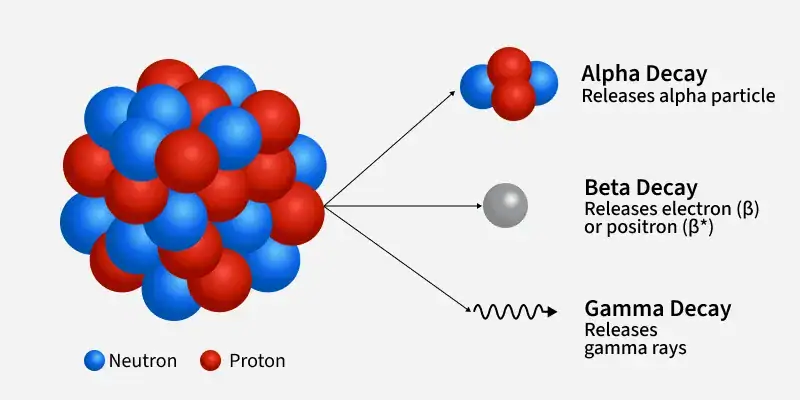
Radioactivity is the phenomenon in which an unstable atomic nucleus spontaneously transforms into a more stable state, releasing particles or electromagnetic radiation. The three common types are alpha (α), beta (β), and gamma (γ) radiation.
The characteristics of each type of radiation determine its penetrating ability, ionizing power, and detection method. These properties are also the basis for selecting a suitable radiation meter and detector.
Nuclear Decay Mechanism
An atomic nucleus consists of protons and neutrons. In some isotopes, the nuclear structure is unstable because of an unfavorable proton-to-neutron ratio or energy state. The nucleus spontaneously transforms and releases energy to reach a more stable state.
The original nucleus is called the parent nucleus, while the product of the decay is the daughter nucleus. The daughter nucleus may undergo further decay, forming a radioactive decay chain.
Radioactive decay occurs spontaneously, and the exact time at which an individual nucleus will decay cannot be predicted. However, for a large number of nuclei, the decay rate follows a well-defined statistical law.
Three Main Types of Radiation
Alpha Decay
An alpha particle consists of 2 protons and 2 neutrons, equivalent to a helium nucleus. When alpha decay occurs, the atomic number decreases by 2 and the mass number decreases by 4.
Alpha radiation has high ionizing power but low penetrating ability. Even a short path through air or a thin layer of material can significantly attenuate alpha radiation.
Therefore, detector geometry and window design are particularly important when measuring alpha radiation. Not every standard radiation meter can effectively detect alpha particles.
Beta Decay
Beta decay occurs when neutrons and protons transform into one another within the nucleus.
β⁻: a neutron transforms into a proton and emits an electron.
β⁺: a proton transforms into a neutron and emits a positron.
Beta radiation is more penetrating than alpha radiation but can still be significantly attenuated when passing through matter.
Depending on the design, a radiation meter may use a Geiger-Müller tube, scintillation detector, or semiconductor detector to detect beta radiation.
Gamma Emission
Gamma radiation is high-energy electromagnetic radiation emitted when a nucleus transitions from an excited state to a lower-energy state.
Gamma radiation has greater penetrating power than alpha and beta radiation, making it particularly relevant for dose-rate measurements and environmental radiation surveys.
Unlike alpha and beta decay, gamma emission does not change the number of protons or neutrons in the nucleus.
What Does a Radiation Meter Measure?
A radiation meter uses a detector to detect ionizing radiation, convert the interaction into an electrical signal, and process that signal to determine the radiation level according to a specific measurement quantity, such as count rate (CPS/CPM) or dose rate (µSv/h, mSv/h).
Depending on its configuration, a radiation meter may display:
CPS/CPM: the number of detected radiation pulses per second/minute.
Bq: radioactive activity, corresponding to the number of nuclear decays per second.
Sv/h: dose rate, indicating the radiation dose received over time.
Energy spectrum: the distribution of radiation event energies, used for more detailed analysis.
It is important to distinguish count rate from dose rate. A CPM or CPS value cannot be directly converted into Sv/h without considering the measurement conditions, detector type, and appropriate calibration factor.
The Detector Determines Measurement Capability
When selecting a radiation meter, the detector is one of the first specifications to consider.
Radioactivity is the spontaneous transformation of unstable atomic nuclei, producing forms of radiation such as alpha, beta, and gamma radiation. Each type interacts with matter differently and therefore requires a different detector. Detection performance depends on the detector type, material, size, sensitivity, energy range, and overall instrument configuration.
Geiger-Müller Tube
A Geiger-Müller (GM) tube uses gas inside the tube to generate an electrical pulse when ionizing radiation passes through it.
Its advantages include relatively simple construction, good sensitivity, and suitability for many portable radiation meters.
However, GM detectors generally do not provide detailed energy information, which limits their ability to identify specific radionuclides.
Ionization Chamber
An ionization chamber measures the electrical current generated by the ionization of gas inside the detector.
This type of detector is commonly used when stable and accurate dose-rate measurement is required, particularly for relatively high radiation levels.
Scintillation Detector
A scintillation detector converts radiation energy into light, which is then converted into an electrical signal.
These detectors offer high sensitivity and can be designed to provide energy information, particularly in gamma-ray measurement systems.
Semiconductor Detector
A semiconductor detector generates electron-hole pairs when radiation interacts with the semiconductor material.
Its major advantage is high energy resolution, making it suitable for systems requiring spectrum analysis or discrimination between different radiation energy levels.
How to Choose a Radiation Meter
When selecting a radiation meter, consider the following factors: radiation type → detector type → measurement quantity → measurement range → calibration requirements.
1. Radiation Type
Check whether the instrument supports α, β, γ, or X-ray radiation. An instrument designed primarily for gamma radiation does not necessarily provide effective alpha detection.
2. Detector Type
Check whether the instrument uses a GM tube, ionization chamber, scintillation detector, or semiconductor detector. This directly affects its sensitivity and measurement capabilities.
3. Measurement Quantity
Determine whether you need to measure CPS/CPM, Bq, Sv/h, or an energy spectrum. Not every instrument supports all of these quantities.
4. Measurement Range and Sensitivity
The measurement range should match the expected radiation level. For low-level measurements, sensitivity and the ability to distinguish radiation signals from background radiation are particularly important.
5. Calibration
Check the instrument's calibration information and applicable measurement conditions. Measurement results are meaningful only when the radiation detector is used with the correct configuration and measurement method.
When selecting a radiation meter, consider the radiation type → detector type → measurement quantity → measurement range → calibration requirements. Among these factors, the detector is particularly important because it determines which types of radiation the instrument can detect and how effectively they can be measured.