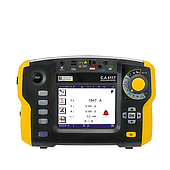
Things to remember before measuring 220V current
Most multimeter have multiple voltage ranges, up to 1000V. When measuring 220V current, you should choose a range higher than this for the meter to operate safely and give accurate results.
Make sure the test probes are firmly inserted into the circuit to be tested. If the connection is loose, the current can be interrupted, creating electrical pulses, damaging both the circuit and the multimeter.
A common mistake is to use the current scale to measure voltage. This can cause the fuse to blow and damage the circuit inside the meter. In particular, if a voltage above 250V is applied to the current scale, the fuse will not be able to protect the components and the risk of damage is very high.
How to measure 220V DC current with a multimeter
To test 220V DC current, you need to prepare a multimeter and the circuit to be measured. The implementation process can be done in the following steps:
Step 1: Switch the meter scale to DC mode, suitable for measuring DC current.
Step 2: Select the voltage scale at 250V, this is a safe level and accurate enough when working with 220V voltage.
Step 3: Insert the red probe into the positive (+) pole and the black probe into the negative (-) pole of the circuit to ensure the correct measurement direction.
Step 4: Connect the meter in series with the circuit to be tested.
Step 5: Turn on the circuit and observe the results displayed on the meter.
If the measurement is higher than 220V, it means that the power source meets the requirements; if lower, the voltage is not up to standard and may affect the performance of the device.
Note: Choosing a scale that is too low will cause the needle to overshoot, while a scale that is too high will result in inaccurate results. At the same time, if you measure DC voltage but leave it in AC mode, the meter will report incorrectly and sometimes twice as high as the actual value, which can damage the device.
How to measure 220V AC current with a multimeter
Things to note before measuring
Before starting, turn off the power to connect the test leads to the location to be tested. When the connection is complete, turn the power back on and start measuring. During the operation, avoid touching the test leads to ensure safety. After reading and recording the results, turn off the power and remove the test leads from the circuit.
Do not plug the test leads into the 15A AC port and do not leave the meter in the mA or Ω scale when working with 220V voltage. In addition, if you accidentally switch to DC measurement mode while measuring AC voltage, the results will be incorrect and the meter may be damaged.
Implementation steps
Step 1: Switch the multimeter to the AC scale to measure alternating current.
Step 2: Insert the black probe into the COM port, the red probe into the (+) port.
Step 3: Select the 250V level, suitable for accurately measuring 220V voltage.
Step 4: Place the two probes at the two points to be tested, making sure they are parallel to each other.
Step 5: Read the displayed result. If the value is close to or greater than 220V, the power source is stable; if lower, the power source may be weak or substandard.
With some types of meters, the AC and DC scales are distinguished by symbols. You can turn the knob to V+ to measure 220V AC voltage and V- for DC voltage.
I have rewritten this content with a more friendly tone, closely following your ideas, the keywords measuring 220V current, multimeter are distributed reasonably and not crammed.
Which type of multimeter should be chosen to measure 220V current?
To measure 220V current accurately and safely, choosing the right type of multimeter is very important. There are many models on the market with different features and prices, so you can consider based on your needs.
Prioritize choosing a meter with a maximum measurement range of about 1000V to flexibly work with many different voltage levels. In addition, quality and durability are also notable factors, because an accurate measuring device will give you more peace of mind during use.
Some of the handheld multimeter that are trusted by many people include Fluke, Hioki, Sanwa, Kyoritsu.., which are famous for their stability and longevity.
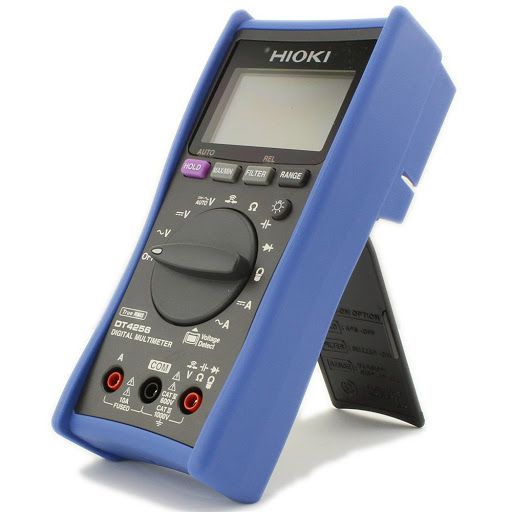
You can choose a Hioki multimeter like the Hioki 3030-10 model, with DCV and ACV scales up to 600 V, supporting effective measurement of DC, AC voltage and resistance. This is an easy-to-use, durable line, meeting CAT III safety standards, and is being distributed by EMIN in Vietnam.
In addition, if you prefer to use analog charts and want to measure AC voltage more accurately, the Kyoritsu 1109S is also a good choice. It has an AC and DC measuring range up to 1000 V, measures DC current, measures resistance, and is officially distributed by EMIN
Frequently Asked Questions (FAQ)
Can a multimeter measure 220V voltage, and can it also measure 220V current?
No. For measuring high current, you should use a clamp meter instead of connecting a multimeter in series, as this is much safer.
To measure current, a multimeter must be connected in series with the load so that the entire current flows through the meter. For high-power loads such as water heaters, air conditioners, or electric motors, attempting to do this can effectively create a short circuit through the meter. In the best-case scenario, the internal fuse will blow. In more severe cases, it can damage the current measurement circuit or even produce an electrical arc, posing a serious safety hazard.
Should I use a True RMS multimeter to measure 220V AC power ?
If you only need to check the voltage of a standard household power outlet, most digital multimeters are sufficiently accurate.
However, in systems that use variable frequency drives (VFDs), UPS systems, solar power inverters, switch-mode power supplies (SMPS), or other non-linear loads, the voltage waveform is no longer a pure sine wave. In these cases, a True RMS multimeter is recommended because it calculates the actual RMS value of the AC signal, providing much more accurate measurements.
Can a multimeter measure voltage directly from a 220V wall outlet ?
Yes. Set the multimeter to AC voltage (VAC) mode, select a voltage range higher than 220V, insert the black probe into the COM terminal and the red probe into the V terminal. Then place the probes into the two slots of the wall outlet to read the voltage.
Why does my multimeter display around 228V instead of exactly 220V ?
The mains voltage naturally fluctuates depending on the electrical load and operating conditions of the power distribution system. A reading between 215V and 230V is generally considered normal for residential electrical networks.
If the voltage frequently drops below 200V, appliances such as water pumps, refrigerators, and air conditioners may operate less efficiently and generate excessive heat.
If the voltage remains above 240V for extended periods, it may reduce the service life of electronic equipment.
For a more accurate assessment, take multiple measurements at different times of the day instead of relying on a single reading.
Is it safe to measure 220V with an inexpensive multimeter ?
Yes, but only if the multimeter comes from a reputable manufacturer and complies with CAT II or CAT III safety standards. Low-quality meters often have poor overvoltage protection and inconsistent measurement accuracy.
Should I wear insulated gloves when measuring 220V ?
If you are working inside an electrical panel, in a damp environment, or on industrial electrical systems, you should use insulated gloves and safety-rated test leads.
For simple residential measurements, always hold only the insulated portion of the test probes and avoid touching any exposed conductive parts.
Can a multimeter measure three-phase electrical systems ?
Yes. A multimeter can measure the voltage between phases or between a phase and neutral, provided its measurement range is suitable.
However, when working on three-phase electrical systems, it is recommended to use a multimeter rated CAT III or CAT IV for enhanced safety.
Do I need to distinguish between positive and negative terminals when measuring 220V AC voltage ?
No. Alternating current (AC) continuously changes direction, so it does not have fixed positive and negative terminals. Simply place the two test probes across the two points you want to measure, and the multimeter will display the corresponding AC voltage.
Why does my multimeter display 0V even though the outlet is live ?
Common causes include:
The meter is set to DC voltage instead of AC voltage.
The test leads are plugged into the wrong input terminals.
The probes are making poor electrical contact.
The multimeter's internal protection fuse has blown.
The multimeter or its battery is faulty.
What do CAT II, CAT III, and CAT IV safety ratings mean ?
When measuring 220V AC, you should consider not only the measurement range but also the measurement category (CAT) safety rating of the multimeter.
For residential electrical work and electrical panel maintenance, it is recommended to use a multimeter rated CAT III 600V or CAT III 1000V, as these ratings provide better protection against transient overvoltage surges commonly encountered in electrical installations.