For full functionality of this site it is necessary to enable JavaScript.
EMINKH.COM
0

Top 6 most searched-for light intensity meters currently available

04/09/2026 10:09:57

Light directly impacts the quality of daily work, from factories and offices to greenhouses. Many businesses encounter the same problem when starting to buy a light meter: there are so many specifications, but they don't know which one to choose. This article focuses on the models currently available at EMIN, which are easy to select, easy to use, and suitable for various purposes

The specific role of a light meter

In many cases, the lighting may look fine, but in practice, it can cause eye strain, color distortion, or affect product quality. Such situations are difficult to identify based solely on perception.

A light meter provides specific readings at each location. This allows you to identify areas that are underlit or overlit, enabling you to adjust the lighting system accordingly.
When should you use a light meter?

In reality, many people only start looking to buy lighting when they encounter one of the following situations:

- Offices with excessive glare or insufficient lighting, causing eye strain for staff.

- Production workshops needing to remeasure illuminance to meet standards.

- Photography studios requiring consistent lighting between sessions.

- Greenhouses needing to monitor light levels for optimal plant growth.

- Construction projects preparing for lighting system acceptance testing.

Top 7 hot selling light intensity measuring devices at EMIN

1. Testo Light Intensity Meter

Coming from a German brand, Testo is renowned for its compact design and high durability. With a measurement range of 99,999 Lux, it offers fast and accurate response, making it suitable for both domestic and industrial testing.

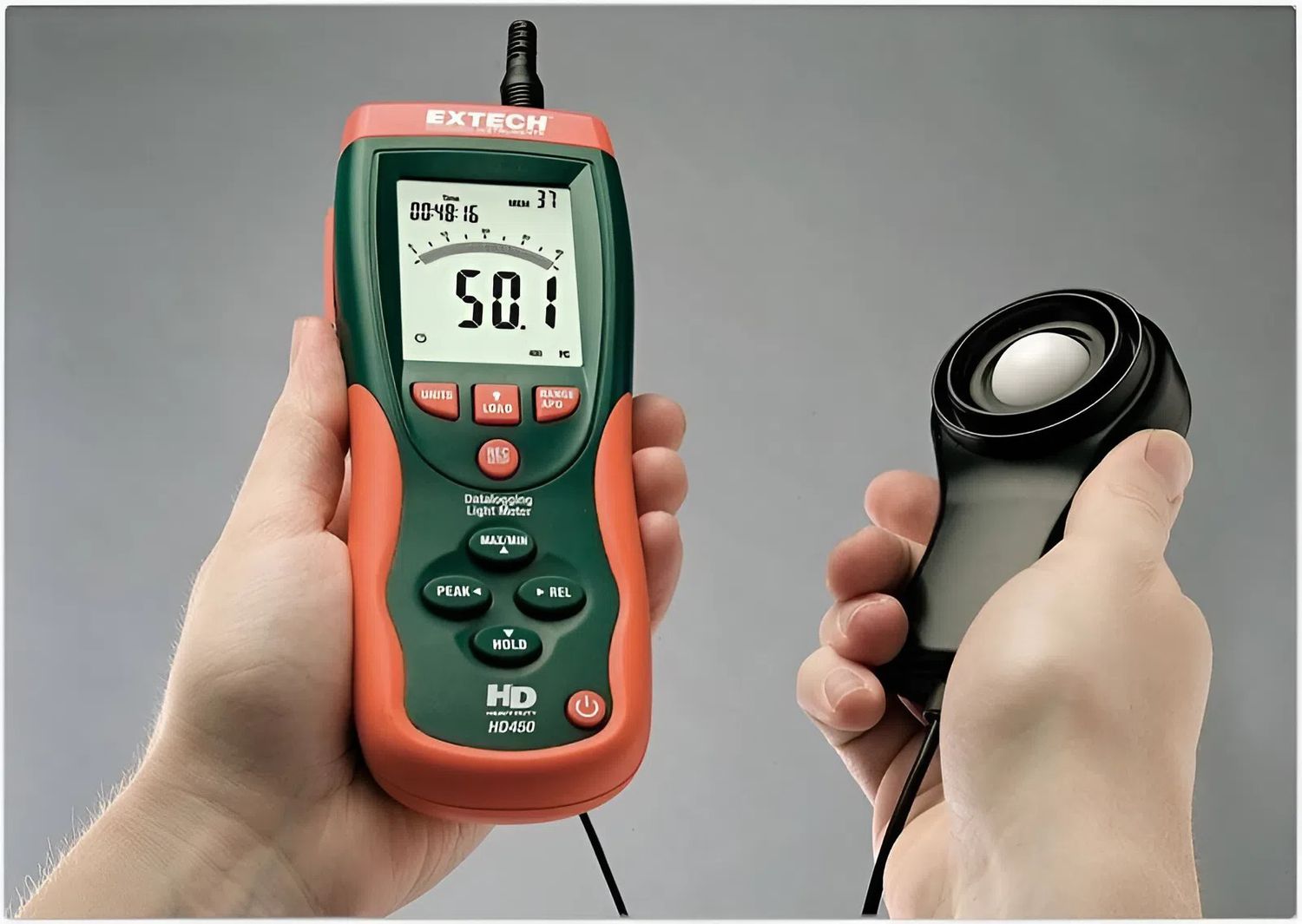
2. Extech Lux Meter

If the job requires measurements in areas with extremely high light intensity, Extech is the suitable choice with a measurement range of up to 400,000 Lux. The detachable sensor makes it easy to operate in tight spaces.

3. Kyoritsu Light Meter

Kyoritsu is a robust and reliable Japanese instrument. Its extremely accurate angle measurement capabilities and low error rate make it a staple in the toolkits of professional electrical and lighting engineers.

4. SNDWAY Light Meter

The outer casing is made of durable ABS plastic, offering good impact resistance. The device automatically switches between measurement ranges flexibly, making it easy for new users to get acquainted with and operate.

5. UNI-T UT383BT Light Intensity Meter

A key feature is the Bluetooth connectivity. You can transfer data directly to your phone for storage and analysis, which is very convenient when you need to create field reports.

6. Kimo LX50 handheld light meter

The device meets IP54 standards, ensuring stable operation in high-humidity environments. This is a specialized model for those requiring absolute precision for testing large-scale lighting projects.

Additionally, you can refer to some topics on light intensity to choose the most suitable model for your needs.

Good lighting for working and studying
The nature of visible light

Related News

Which products are tested using a -40°C to +150°C thermal shock chamber?
07/22/2026 14:45:25

Automotive circuit boards, sensors, modules, and plastic components can all experience issues after repeated transitions between cold and hot environments. A thermal shock chamber operating from -40°C to +150°C enables the replication of these temperature fluctuations under controlled testing conditions.

Does thermal shock cause damage to electronic components?
07/22/2026 10:40:49

An electronic component may operate stably under constant temperature conditions yet fail after repeated rapid transitions between hot and cold. The issue typically stems not from a specific temperature level, but rather from the rate of temperature change and the number of hot-cold cycles

The rigorous standards behind a multi-million-dollar MRI suite
07/21/2026 14:54:01

An MRI system may be correctly installed and fully connected to the power supply, yet still encounter issues if the surrounding environment fails to meet technical specifications. Electromagnetic interference, RF shielding, power quality, grounding, temperature, humidity, and particulate levels are all factors that may require assessment, depending on the facility's design and the manufacturer's requirements.

Sinusoidal and Random Vibration: A Test Setup Guide for Industrial Engineers
07/21/2026 10:30:38

During the operation of industrial machinery or the transportation of goods, persistent mechanical vibrations inevitably occur; these are a primary cause of material fatigue, loosened connections, and cracking in printed circuit boards (PCBs). To ensure product integrity before delivery to customers, R&D and QA/QC engineers must simulate these dynamic forces using vibration test systems.

Capacities of laboratory centrifuge tubes
07/20/2026 13:55:40

Tubes with capacities of 0.2 ml, 1.5 ml, 15 ml, or 50 ml are commonly found in laboratories, yet each type is associated with specific sample categories and equipment configurations. DNA and RNA samples typically require small-volume microtubes; blood and cell samples often utilize 5 ml or 15 ml tubes; while large-volume processing workflows may require tubes of 50 ml, 100 ml, or greater capacity

Stay Updated with Offers

Get exclusive volume discounts, bulk pricing updates, and new product alerts delivered directly to your inbox.

By subscribing, you agree to our Terms of Service and Privacy Policy.

Quick Support

Direct access to our certified experts