For full functionality of this site it is necessary to enable JavaScript.
EMINKH.COM
0

Unveil the Serial Buses Design - Debug & Troubleshoot Webinar

04/28/2020 16:41:32

Webinar organized by Tektronix, on 9:00 am on 13/5/2020. Please register to attend

Serial bus systems are literally everywhere in our society today. Traditionally, parallel buses are widely used for communicating between the devices in micro-controller and DSP-based designs. Today, however, more and more of the building blocks used in design are replacing these wide parallel buses with serial buses due to less power consumption, differential signaling for better noise immunity and fewer pins and therefore, require less board space.
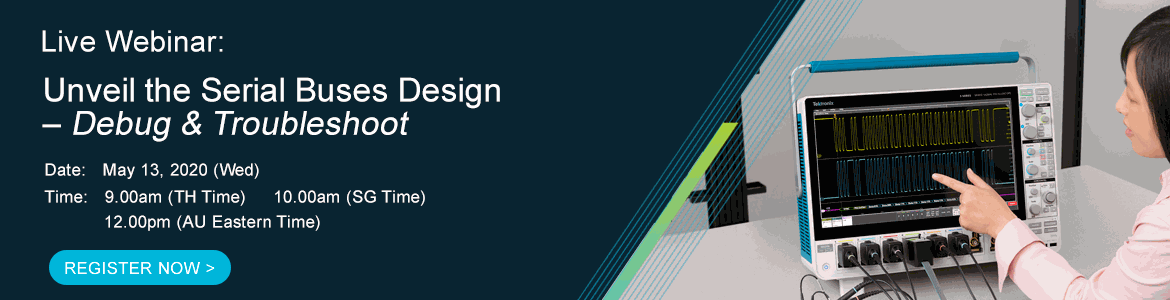

While serial buses provide a number of advantages, they also pose some significant challenges to a designer due simply to the fact that information is being transmitted in a serial fashion rather than parallel. The difficulty lies in extracting information about the protocol itself and in determining the interactions between devices from a long serial stream of data.


Join our webinar to understand the common challenges for serial bus designers and learn how you can overcome them.



Related News

Which products are tested using a -40°C to +150°C thermal shock chamber?
07/22/2026 14:45:25

Automotive circuit boards, sensors, modules, and plastic components can all experience issues after repeated transitions between cold and hot environments. A thermal shock chamber operating from -40°C to +150°C enables the replication of these temperature fluctuations under controlled testing conditions.

Does thermal shock cause damage to electronic components?
07/22/2026 10:40:49

An electronic component may operate stably under constant temperature conditions yet fail after repeated rapid transitions between hot and cold. The issue typically stems not from a specific temperature level, but rather from the rate of temperature change and the number of hot-cold cycles

The rigorous standards behind a multi-million-dollar MRI suite
07/21/2026 14:54:01

An MRI system may be correctly installed and fully connected to the power supply, yet still encounter issues if the surrounding environment fails to meet technical specifications. Electromagnetic interference, RF shielding, power quality, grounding, temperature, humidity, and particulate levels are all factors that may require assessment, depending on the facility's design and the manufacturer's requirements.

Sinusoidal and Random Vibration: A Test Setup Guide for Industrial Engineers
07/21/2026 10:30:38

During the operation of industrial machinery or the transportation of goods, persistent mechanical vibrations inevitably occur; these are a primary cause of material fatigue, loosened connections, and cracking in printed circuit boards (PCBs). To ensure product integrity before delivery to customers, R&D and QA/QC engineers must simulate these dynamic forces using vibration test systems.

Capacities of laboratory centrifuge tubes
07/20/2026 13:55:40

Tubes with capacities of 0.2 ml, 1.5 ml, 15 ml, or 50 ml are commonly found in laboratories, yet each type is associated with specific sample categories and equipment configurations. DNA and RNA samples typically require small-volume microtubes; blood and cell samples often utilize 5 ml or 15 ml tubes; while large-volume processing workflows may require tubes of 50 ml, 100 ml, or greater capacity

Stay Updated with Offers

Get exclusive volume discounts, bulk pricing updates, and new product alerts delivered directly to your inbox.

By subscribing, you agree to our Terms of Service and Privacy Policy.

Quick Support

Direct access to our certified experts