In the woodworking and furniture manufacturing industry, wood is often regarded as a "living" material because it continuously exchanges moisture with the air. This natural process causes dimensional changes, warping, swelling, and cracking over time. Throughout the manufacturing process, using a wood moisture meter helps produce furniture with higher quality, greater stability, and a longer service life.
Equilibrium Moisture Content Instead of Maximum Drying
Equilibrium Moisture Content (EMC) is the condition in which wood no longer absorbs or releases moisture to the surrounding air.
For example, if lumber is dried excessively to only 5–6% moisture content but is later installed in a humid environment such as a kitchen or northern Vietnam during the humid season, it will rapidly absorb moisture and expand. This can lead to swollen joints, sticking doors, and dimensional instability.
Conversely, wood that is not sufficiently dried before being installed in an air-conditioned room will lose moisture quickly, resulting in shrinkage and surface cracks.
Therefore, the objective of wood conditioning is not to remove every drop of water from the material, but to bring the wood to a moisture content that matches the climate in which it will ultimately be used.
Wood Moisture Standards for Different Applications
Depending on wood density, grain structure, and intended use, manufacturers rely on a wood moisture meter to monitor moisture content accurately throughout production.
Wood for Export: Export markets such as the United States and Europe typically have relatively dry climates, with central heating systems operating for much of the year. Finished wood products destined for these regions generally require a moisture content between 6% and 8% to ensure dimensional stability after installation.
Indoor Furniture in Vietnam: Vietnam's tropical monsoon climate experiences significant seasonal humidity fluctuations. For indoor furniture such as kitchen cabinets, tables, chairs, wardrobes, and beds, the recommended moisture content is typically 10% to 12%. This range provides sufficient flexibility to withstand changing weather conditions while minimizing excessive shrinkage in air-conditioned environments.
Construction Timber and Outdoor Applications: Outdoor structures—including pool decking, entrance gates, pergolas, and exterior louvers—are constantly exposed to rain and sunlight. For these applications, wood moisture content should generally be maintained between 15% and 18%.
Drying exterior timber below this range can actually reduce its durability, making the wood more susceptible to cracking when exposed to seasonal rainfall.
Hidden Moisture Trapped by Adhesives and Surface Finishes
A common issue in woodworking workshops occurs when lumber appears to have an ideal moisture reading, yet finished products develop bubbles after veneer lamination or adhesive bonding.
In many cases, water-based or solvent-based adhesives introduce additional moisture into the surface layer of the wood. If polyurethane (PU) coating is applied before this moisture has fully evaporated, the trapped water turns into vapor when exposed to heat, creating bubbles beneath the finish.
Another frequent mistake is relying on traditional inspection methods, such as tapping the wood to judge its sound or estimating moisture by its color.
Freshly kiln-dried lumber may appear dry on its outer 1–2 mm surface while still retaining significant moisture deep inside the core. Once the wood is cut or machined, this internal moisture imbalance can quickly cause boards to warp within just a few hours.
Quality Control with a Handheld Wood Moisture Meter
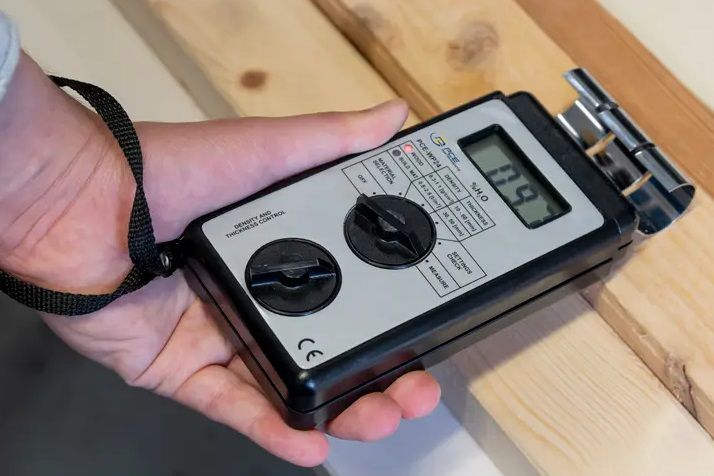
Based on electrical resistance or electromagnetic capacitance technology, a handheld wood moisture meter delivers accurate moisture readings in just a few seconds.
In professional woodworking shops, technicians often combine both measurement technologies for the most reliable results.
Pinless Moisture Meters (Non-Destructive Testing): With a pinless wood moisture meter, the operator simply places the sensor against the wood surface. High-frequency electromagnetic waves penetrate beneath the surface to measure overall moisture content without leaving scratches, holes, or marks, making this method ideal for finely sanded or high-value finished wood.
Pin-Type Moisture Meters (Minimally Invasive Testing): Pin-type meters use two hardened steel probes inserted into the wood grain, particularly at the end grain or deep into thick timber sections. By measuring electrical resistance between the probes, they accurately detect hidden moisture inside the wood, revealing situations where the surface is dry but the core remains damp. This ensures the entire piece has reached a consistent and stable moisture level.
Using a wood and construction moisture meter enables woodworking businesses to protect valuable raw materials, optimize kiln-drying schedules, reduce production defects, and improve product consistency. Accurate moisture measurement not only minimizes costly waste but also enhances product quality and strengthens a manufacturer's reputation in competitive furniture and construction markets.