
What is the nature of Diode?
Diode is a familiar electronic component in electrical circuits, helping the current to flow in only one direction. Before learning how to test a diode with a multimeter, let's see how it is constructed.
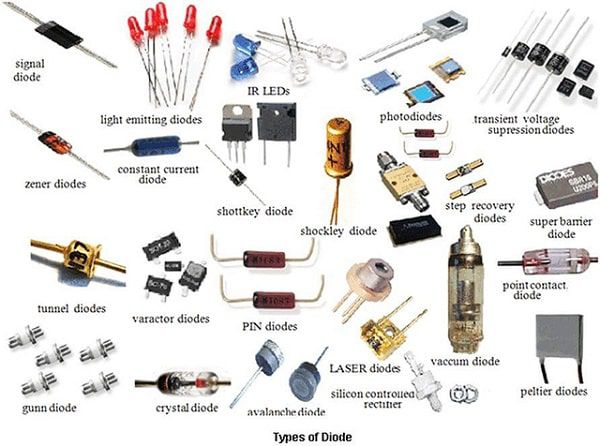
Diode is made up of two layers of semiconductor type P and N, formed from a combination of Silicon, Phosphorus and Boron. When these two layers come into contact with each other, they form two poles: Anode (A) on the P semiconductor side and Cathode (K) on the N semiconductor side. The characteristic of a diode is the ability to only allow current to flow from Anode to Cathode, helping to control the current in the circuit and prevent current from flowing in the opposite direction.
Common types of diodes on the market
Each type of diode has its own characteristics and applications in the circuit. Here are some common types:
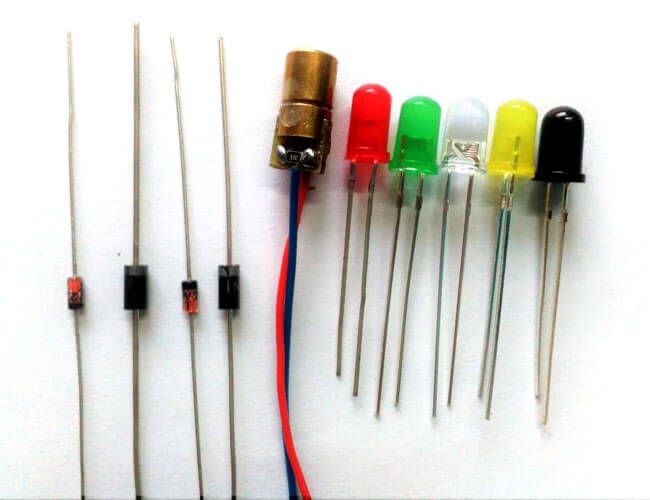
Rectifier diode: Specialized in converting alternating current to direct current. This type operates at low frequencies and can withstand large currents, commonly found in power supplies.
Light-emitting diode (LED): Widely used in lighting, signal lights and billboards thanks to its ability to emit light when an electric current passes through it.
Bidirectional pulse-limiting diode (TVS): Operates at high frequencies, from tens of kHz to MHz. Often used in switching power supplies and high-frequency electronic devices to protect circuits from sudden voltage spikes.
Varicap diode: This type of diode has the ability to change its capacitance according to the applied voltage level, often used in frequency regulation circuits such as radio receivers.
Zener diode: Operates in reverse bias mode, helping to stabilize the voltage in the circuit by maintaining a fixed voltage level when breakdown occurs.
Check diode with digital multimeter
To determine whether the diode is still working or not, you can use a digital multimeter and follow these steps:
Determine the polarity of the diode: It is necessary to correctly identify the positive pole (Anode) and negative pole (Cathode) before measuring.
Connect the measuring probe: Place the red probe of the meter on the positive pole, the black probe on the negative pole.
Check the measured value: If the display shows a voltage of 0.6 - 0.7V, the diode is still working well. For germanium diodes, this value will be lower, about 0.25 - 0.3V.
Reverse the probes: Place the red probe on the negative pole and the black probe on the positive pole. The diode will then be reverse biased and will not conduct electricity.
Evaluate the results: If the display shows [OL], the diode is still good. On the contrary, if there is a voltage value or nothing is displayed, the diode may be damaged due to an open circuit or a short circuit.
Tips for testing diodes with Fluke 87V Max
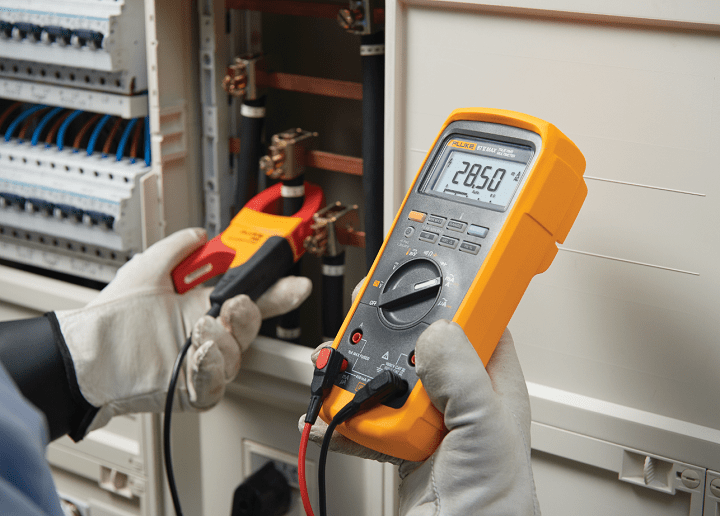
Fluke 87V Max is one of the high-end multimeters from FLUKE, high durability and accurate measurement, needless to say, suitable for testing diodes in many different working environments. Below are detailed instructions on how to use Fluke 87V Max to test diodes:
- Switch to diode measurement mode: Turn on the meter and turn the knob to "Diode Test" mode (triangle symbol with a dash).
- Connect the test probe:
Plug the black test probe into the COM port.
Plug the red test probe into the VΩ port.
- Measure in the forward direction:
Place the red probe on the positive terminal (Anode) and the black probe on the negative terminal (Cathode) of the diode.
If the diode is still working, the display will show a voltage drop, usually between 0.6 - 0.7V for silicon diodes, or 0.25 - 0.3V for germanium diodes.
- Measure in reverse:
Change the probe position: red probe on Cathode, black probe on Anode.
At this time, the diode will not conduct electricity, and the display will show OL (Over Limit), indicating that no current is flowing through.
- Evaluate the results:
If the measurement results are as above, the diode is still working normally.
If the voltage displayed in both cases or always OL, the diode may have an open circuit or a short circuit.
Currently, the Happy March promotion program, Hunting for sales with Fluke is still taking place, please quickly refer to "International Promotion of Happiness" HAPPY MARCH, HUNT FOR SALE WITH FLUKE" to have the opportunity to hunt for a super cool multimeter to measure diodes safely!

![[Golden Opportunity] Buy a Tektronix 2 Series MSO Oscilloscope - Get a free optional package today!](/s-cdn/3c/3c94af7fb9f6e29d68ca6caa5a0bf0a6f220022e.png)