Associated Research (ARI) was founded in the United States in 1936. Following the success of the battery-operated Vibrotest insulation resistance tester, the company introduced the world's first commercial AC Hipot tester, establishing a brand-new standard in the field of electrical safety testing. The withstand voltage testing method subsequently became the foundation for numerous international standards such as UL and IEC as well as many testing procedures used on modern production lines.
Nearly a century later, Associated Research remains dedicated to developing specialized electrical safety testing systems, featuring three renowned product lines: Hypot, HypotULTRA, and HypotMAX. As each line serves specific applications, understanding the intended purpose of each device enables businesses to make the right choice from the start, avoiding either over-investment or the acquisition of equipment that fails to meet their needs.
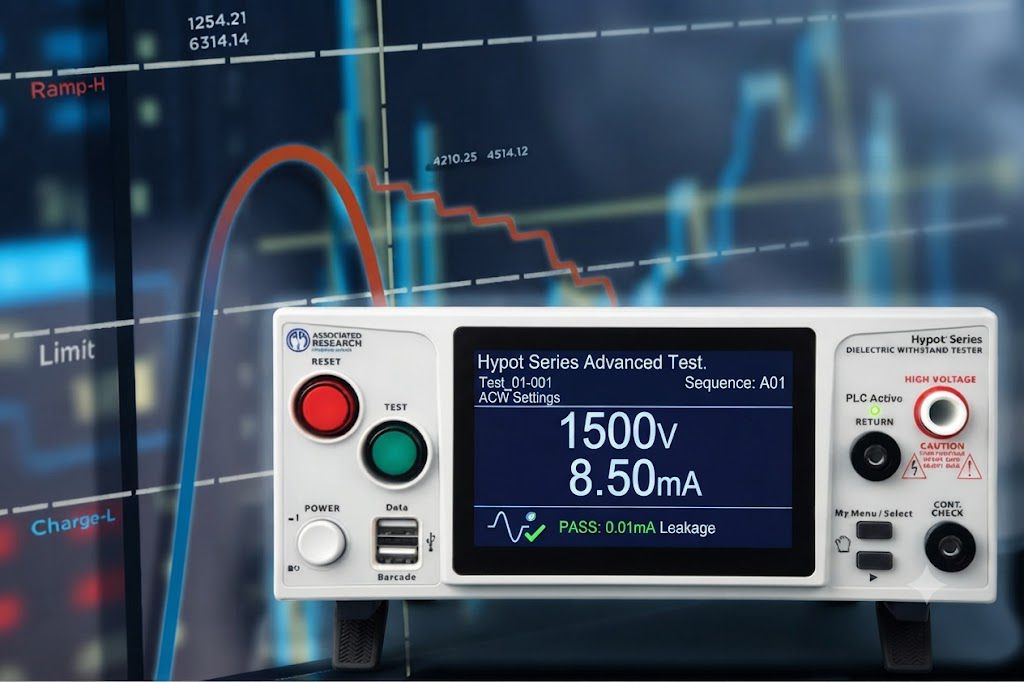
Find the differences between Hypot, HypotULTRA, and HypotMAX
A look at EMIN’s product lineup reveals names that are quite similar, leading many to assume that the Hypot, HypotULTRA, and HypotMAX models differ only in price or specifications. In reality, however, the development focus for each of these three series differs right from the intended application stage.
The Hypot series focuses on standard production-line tests such as AC Hipot, DC Hipot, and insulation resistance designed to meet the need for rapid, simple testing.
With the HypotULTRA series, the focus shifts from mere test voltage capabilities to data management, automation, and result traceability; these models are typically found in manufacturing facilities that require test record-keeping, barcode scanner connectivity, or integration with MES and ERP systems.
Meanwhile, HypotMAX was developed for very high-voltage testing; applications such as transformers, high-voltage cables, large-scale industrial equipment, or R&D laboratories often require testing capabilities of up to 20 kV exceeding the range of standard Hipot models.
For which tests should the Hypot series be selected?
For manufacturers of consumer electrical appliances, power cords, adapters, electric fans, household goods, or general electronic products, a critical step is verifying that the product withstands the test voltage and that its insulation meets the required standards.
That is why EMIN recommends the widely used Hypot 3805, Hypot 3865, and Hypot 3870 series.
Specifically:
- The Hypot 3805 is suitable for applications requiring only AC Hipot testing.
- The Hypot 3865 adds AC and DC Hipot testing capabilities along with insulation resistance (IR) measurement.
- The Hypot 3870 expands upon Hipot and IR testing by adding a Ground Continuity check, making it suitable for production lines requiring more comprehensive evaluation.
A notable feature of this new Hypot generation is the integration of capabilities typically found only in larger systems directly into the unit itself—such as SmartGFI® for operator shock protection, Arc Detection to identify arcing events, onboard storage for test configurations, and rapid data retrieval via a front-panel USB port.
Why do many automated factories choose HypotULTRA?
As production volumes rise to thousands of units daily, a simple "Pass" or "Fail" result per test is no longer sufficient for effective quality management. Each product requires the logging of its serial number, test timestamp, test voltage, leakage current, and full testing history to ensure traceability in the event of an issue or for future quality assessment. This is precisely why Associated Research developed the HypotULTRA series, designed for production lines that require both electrical safety testing and systematic data management.
A prime example is the Associated Research 7850 model. In addition to supporting AC Hipot, DC Hipot, and Insulation Resistance testing along with features like a touchscreen interface, multiple test configurations, direct barcode scanner connectivity, and data export capabilitiesthe HypotULTRA series delivers its greatest value through its ability to manage test data for individual products directly on the production line.
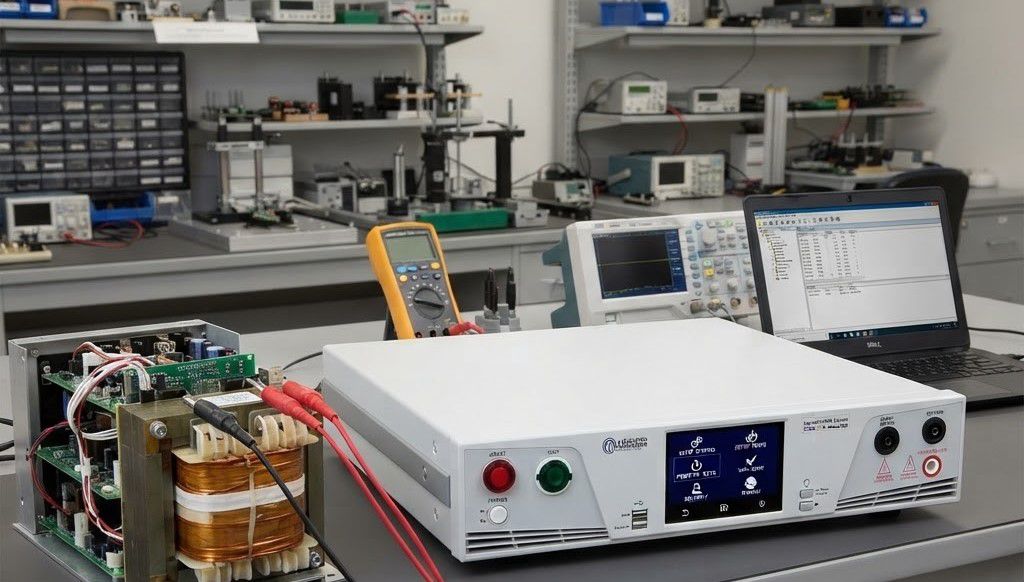
Some tests require voltages of up to 20 kV; do you know why?
Voltage levels of 5 kV or 6 kV suffice for the majority of electrical safety tests on household appliances, consumer electronics, and various industrial products. However, high-voltage cables, specialized insulation materials, transformers, and certain power transmission equipment require significantly higher test voltages to evaluate the withstand capability of their insulation systems.
This is why Associated Research developed the HypotMAX series, offering test voltages of up to approximately 20 kV AC or DC (depending on the model). These instruments are commonly found in R&D labs, materials testing facilities, and manufacturing plants for industrial electrical equipment that require high-voltage testing.
Furthermore, selecting the right equipment from the start helps optimize investment costs and prevents unnecessary future expenditures. A production line performing only standard AC or DC Hipot testing would struggle to fully utilize the capabilities of the HypotMAX. Conversely, if a product requires test voltages exceeding the limits of the Hypot or HypotULTRA series, investing in the appropriate model initially is more cost-effective than having to overhaul the entire system later as testing requirements evolve.
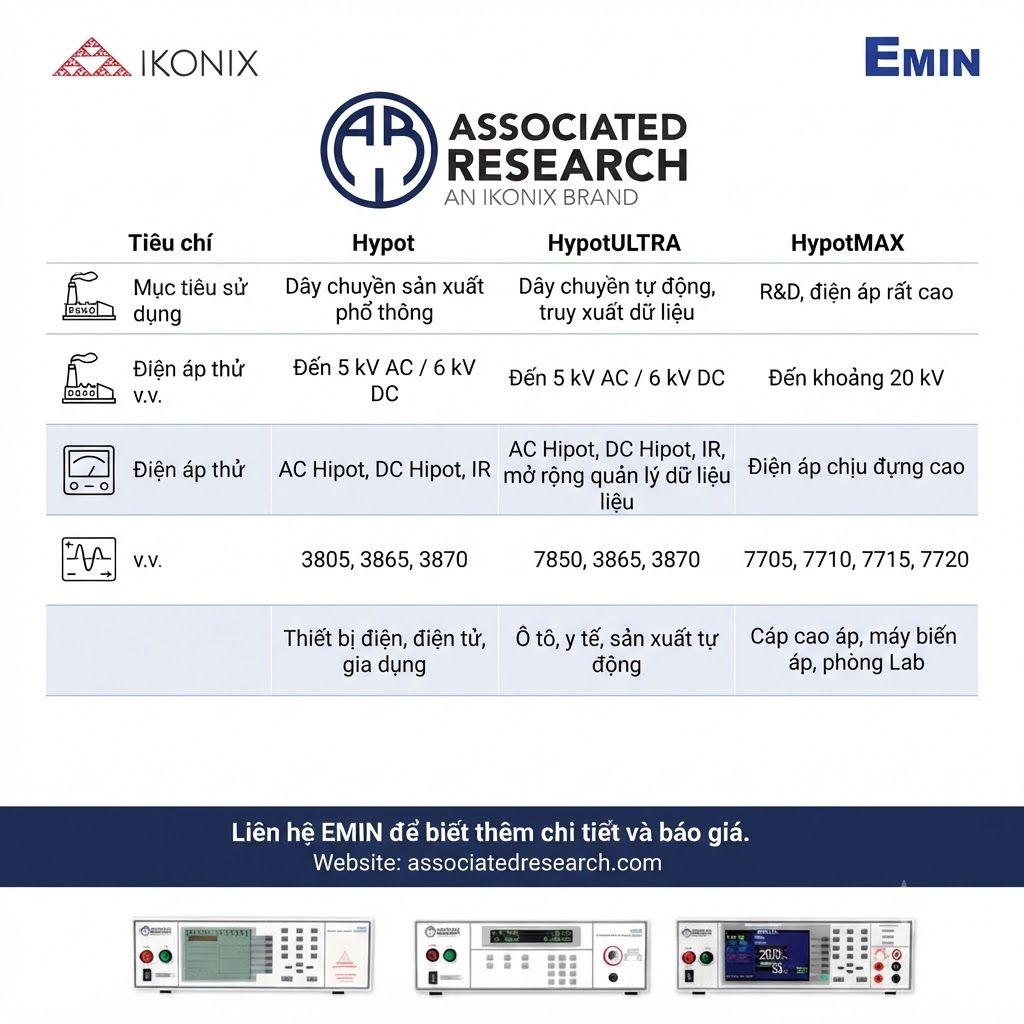
Quick comparison of Hypot, HypotULTRA, and HypotMAX
For an objective overview, here is a quick comparison table of the three product lines:
We hope this article has provided a clearer perspective on the differences between Associated Research's electrical safety tester lines. If you need assistance selecting a configuration that suits your products or the testing standards you are applying, EMIN is ready to provide detailed consultation; please contact us directly via the EMIN Group website or fanpage.