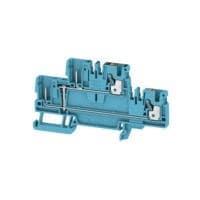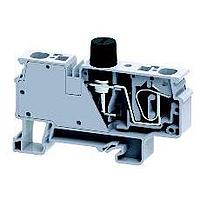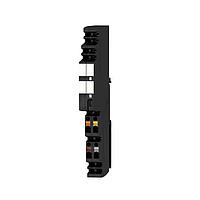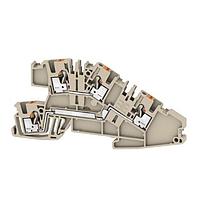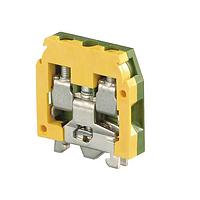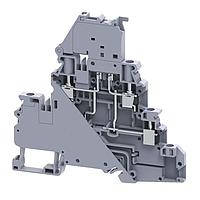
Industrial Terminal Blocks
Reliable field wiring starts with connections that are easy to identify, quick to service, and stable over time. In control panels, machine wiring, and distributed I/O assemblies, Industrial Terminal Blocks help organize conductors into a structured, maintainable interface between power, signal, and control circuits.
This category supports applications where wiring density, service access, and electrical separation matter just as much as the electrical connection itself. Whether you are building new panels or upgrading existing systems, the right terminal block strategy can reduce installation errors, simplify troubleshooting, and make future expansion more practical.
Why terminal blocks matter in industrial automation
Terminal blocks are often treated as small components, but they play a major role in overall panel reliability. They provide a defined connection point for incoming and outgoing wiring, helping technicians route conductors clearly and maintain separation between different circuit functions.
In industrial environments, this matters for more than neatness. Clear wiring architecture supports faster commissioning, safer maintenance, and easier fault isolation. When terminal blocks are selected correctly for conductor type, current path, and mounting method, they become a dependable foundation for automation systems.
Typical use cases across panels and machines
Industrial terminal blocks are widely used in control cabinets, junction boxes, OEM machinery, process skids, and building automation assemblies. They are suitable for connecting field devices such as sensors, switches, actuators, relays, and low-voltage control wiring into a central termination point.
They are also commonly used wherever systems need to be modular. For example, a panel may route field signals to industrial controllers, while separate terminal positions are reserved for power distribution, commons, grounding, and future I/O additions. This structure helps engineering teams standardize layouts across multiple machines or production lines.
Common product types in this category
This category typically covers several connection and support formats, each suited to a different wiring approach. DIN rail terminal blocks are commonly used for organized panel layouts because they allow fast mounting, grouping, and replacement. Interface-style modules can help bridge field wiring and controller-side connections in systems where signal organization is important.
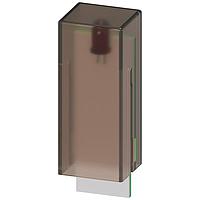
Accessories are also part of the overall solution. Markers, jumpers, end stops, covers, and related installation items help create a complete termination system rather than a single isolated connection point. In many projects, these supporting parts are just as important as the block itself because they improve labeling, isolation, and long-term maintenance access.
What to consider when selecting industrial terminal blocks
The best choice depends on the wiring task, not just on physical fit. Start with conductor size, connection style, mounting preference, and the role of the circuit. A terminal used for a low-level signal path may be selected differently from one used for higher-current distribution or repeated maintenance access.
It is also important to consider panel layout and serviceability. High-density assemblies may need compact spacing, while maintenance-heavy equipment may benefit from terminal arrangements that are easier to inspect and replace. If the panel includes related subsystems such as circuit protection devices or switching hardware, the terminal block arrangement should support safe routing and clear segregation of those circuits.
Fit within the broader automation ecosystem
Terminal blocks do not operate in isolation. They sit between field wiring, control hardware, and power distribution components, acting as a practical interface layer inside automation architecture. In many designs, they help bridge sensors, operator devices, and peripheral equipment into the main control scheme.
For example, machine builders may combine terminal blocks with control components, motor starters, or contactors to create organized cabinet wiring. In systems with inspection or machine vision elements, clean field termination can also support devices from related areas such as cameras and accessories. Good termination practice improves the maintainability of the entire system, not just the wiring section where the blocks are mounted.
Manufacturers commonly considered for industrial connectivity and automation
This category may be relevant to buyers comparing solutions from established industrial and connectivity-focused brands. Names such as Advantech, 3M, Banner Engineering, Amphenol, Amphenol FCI, and AMP Connectors - TE Connectivity are often part of broader automation and interconnection projects, depending on the panel architecture and application requirements.
Selection usually depends less on brand visibility alone and more on compatibility with the overall build standard, enclosure layout, and maintenance preferences. For engineering teams, consistency across connection hardware, control components, and documentation can be just as important as the part itself.
Practical buying approach for B2B projects
When sourcing industrial terminal blocks for OEM, panel shop, or MRO use, it helps to define the application in terms of wiring volume, maintenance frequency, and expected panel expansion. Standardization across projects can make spare part management easier and reduce engineering variation from one build to the next.
It is also useful to think in terms of the full connection workflow: mounting, conductor termination, identification, testing, and service replacement. A well-matched terminal block setup supports cleaner assembly and fewer wiring ambiguities during startup and maintenance. That makes this category especially important for teams focused on uptime, repeatability, and orderly control cabinet design.
Choosing with long-term maintenance in mind
Industrial terminal blocks are a small but essential part of dependable automation infrastructure. The right configuration supports organized wiring, clearer documentation, and easier intervention when systems need to be expanded, inspected, or repaired.
For buyers evaluating panel components, the goal is not simply to find a connection point, but to choose a termination approach that fits the operating environment and the broader control system. A well-planned terminal block layout helps create automation assemblies that are easier to build today and easier to maintain over time.
Get exclusive volume discounts, bulk pricing updates, and new product alerts delivered directly to your inbox.
By subscribing, you agree to our Terms of Service and Privacy Policy.
Direct access to our certified experts