
For full functionality of this site it is necessary to enable JavaScript.
EMINKH.COM
0

Low-distortion measurements with high-resolution oscilloscopes

11/19/2021 10:44:32

**Basic fault-finding** The PicoScope 4262 is a high-precision oscilloscope that is also suitable for general-purpose fault-finding. With two input channels,

Basic fault-finding

The PicoScope 4262 is a high-precision oscilloscope that is also suitable for general-purpose fault-finding. With two input channels, it can display signals in both time domain and frequency domain views, or even both at the same time. Spectrum views provide a number of automatic measurements including distortion and noise.

Dynamic range

The analog to digital converters in most digital oscilloscopes have 8-bit resolution, which produces 256 quantization levels. This is equivalent to an ideal dynamic range of 48 dB. The PicoScope 4262 has a 16-bit analog to digital converter which produces 65,536 quantization levels, increasing the dynamic range to 96 dB.

96 dB is the best theoretical figure, but in practice the acquisition system will have some noise that will reduce the actual usable dynamic range.

The dynamic range of the generator and acquisition system was measured with the generator output directly connected to the channel A input, as in Figure 1.
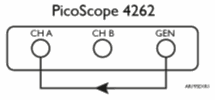
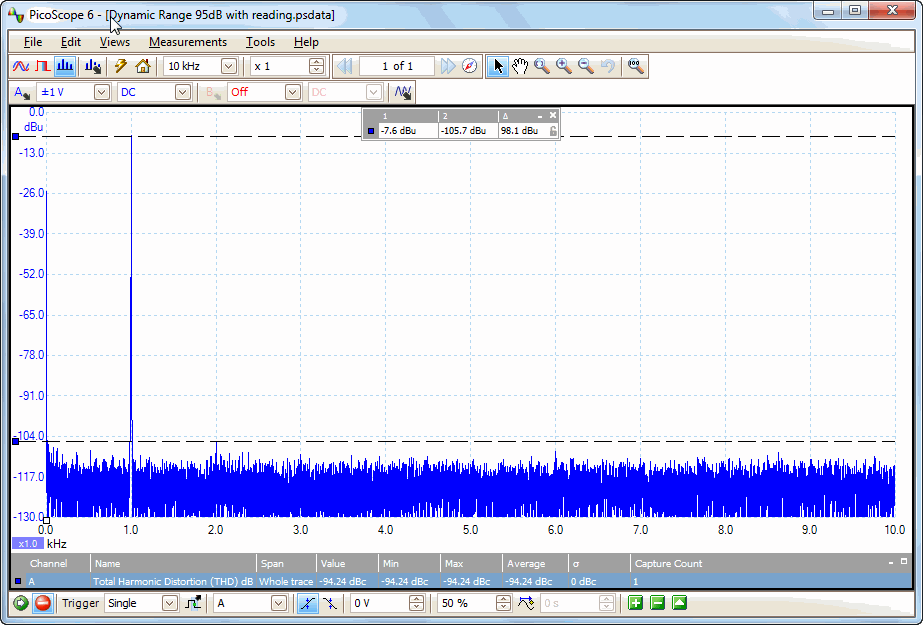
Figure 1: Measuring dynamic range by feeding signal from built-in generator into oscilloscope

Figure 2 shows the spectrum view in PicoScope. This was obtained by capturing the sine wave signal in the time domain and then clicking the Spectrum button.

To measure the dynamic range we aligned the two channel A rulers (controlled by the blue squares next to the y-axis) with the signal peak and the noise floor. The ruler legend then showed the dynamic range, given by the delta between the two rulers, to be –98 dB.

Monitoring waveform distortion

This test measures distortion in a stereo amplifier. It shows how PicoScope’s automatic distortion measurement can detect harmonics even when the time-domain waveform looks clean. The PicoScope 4262 has more than enough dynamic range to capture these signals without adding significant noise or distortion of its own.

Figure 3: Setup for distortion measurement

Figures 4 and 5 show the PicoScope screen divided into four views: a time-domain and a spectrum view for each of the two channels. Each view is easily created by right-clicking on the default view and selecting Add View.
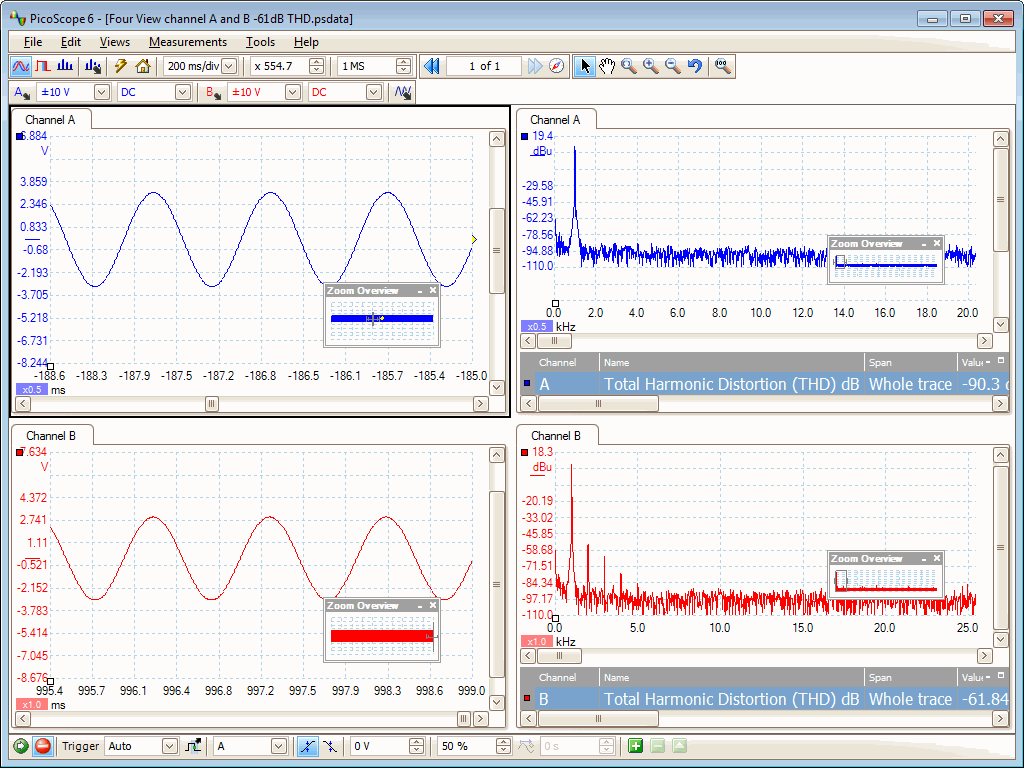
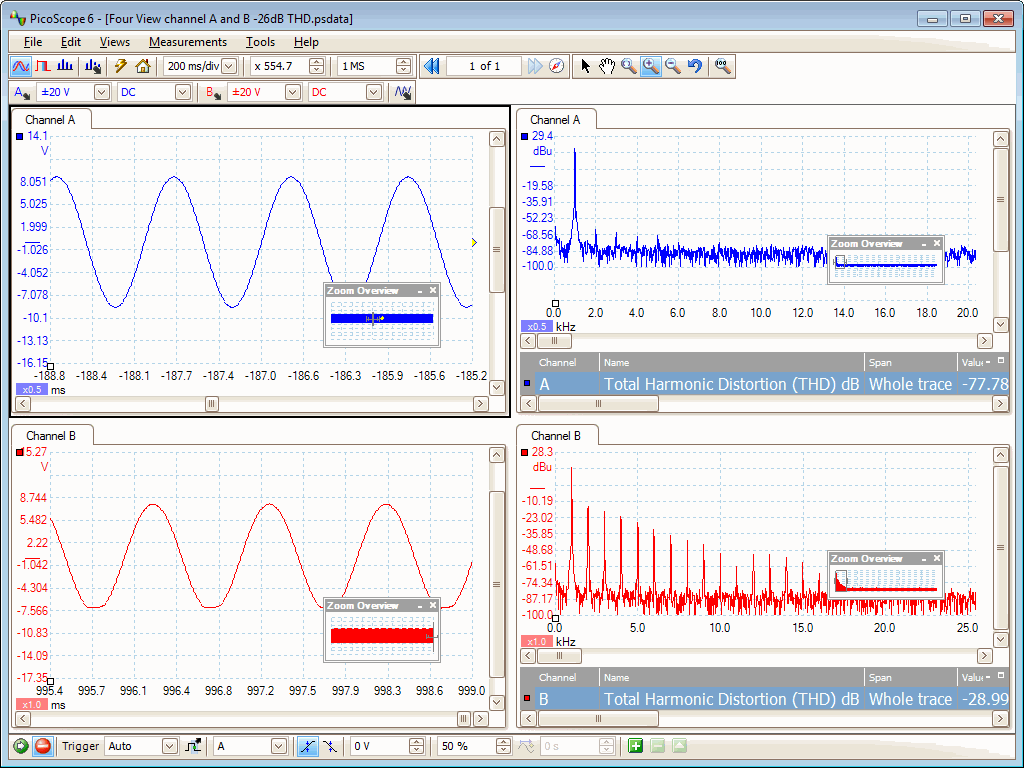
Figure 4: Four views, channels A and B Channel B has –61 dB THD. In the time-domain view we cannot see distortion.

Figure 5: Four views, channels A and B With increased power output level, we can start to see some distortion harmonics in the channel A spectrum display.

The channel B spectrum has THD of –28 dB at this level. We can start to see the distortion in the time-domain display (lower left panel).

Glitch detection

PicoScope’s Persistence Display mode is useful for capturing unwanted clicks or glitches in an audio signal. In a normal oscilloscope display these signals appear on the screen for only a fraction of a second, so there is little chance of performing accurate measurements on them. Persistence mode causes old waveforms to remain in the background while newer waveforms are drawn on top.

The main choice to be made in Persistence Options is between Color Persistence and Analog Intensity modes.

Color Persistence mode, as shown in Figure 7, can display new updates in brighter colors than old waveforms, making glitches stand out.

Analog Intensity mode has a similar effect but using shades of a single color. This is more like the display of an analog persistence scope.
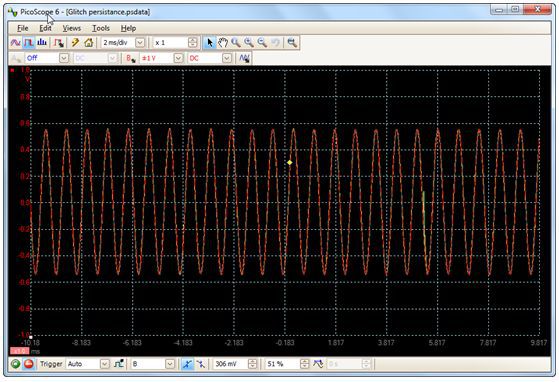
Figure 7: Color Persistence mode, showing a glitch in a brighter color

Conclusion

The high resolution of the PicoScope 4262 makes it ideal for low-noise, low-distortion measurements, and its built-in signal generator removes the need for an additional signal source. With its 5 MHz bandwidth, it can easily analyze audio, ultrasonic and vibration signals, characterize noise in switched mode power supplies, measure distortion and perform a wide range of precision measurement tasks.

Related News

Does thermal shock cause damage to electronic components?
07/22/2026 10:40:49

An electronic component may operate stably under constant temperature conditions yet fail after repeated rapid transitions between hot and cold. The issue typically stems not from a specific temperature level, but rather from the rate of temperature change and the number of hot-cold cycles

The rigorous standards behind a multi-million-dollar MRI suite
07/21/2026 14:54:01

An MRI system may be correctly installed and fully connected to the power supply, yet still encounter issues if the surrounding environment fails to meet technical specifications. Electromagnetic interference, RF shielding, power quality, grounding, temperature, humidity, and particulate levels are all factors that may require assessment, depending on the facility's design and the manufacturer's requirements.

Sinusoidal and Random Vibration: A Test Setup Guide for Industrial Engineers
07/21/2026 10:30:38

During the operation of industrial machinery or the transportation of goods, persistent mechanical vibrations inevitably occur; these are a primary cause of material fatigue, loosened connections, and cracking in printed circuit boards (PCBs). To ensure product integrity before delivery to customers, R&D and QA/QC engineers must simulate these dynamic forces using vibration test systems.

Capacities of laboratory centrifuge tubes
07/20/2026 13:55:40

Tubes with capacities of 0.2 ml, 1.5 ml, 15 ml, or 50 ml are commonly found in laboratories, yet each type is associated with specific sample categories and equipment configurations. DNA and RNA samples typically require small-volume microtubes; blood and cell samples often utilize 5 ml or 15 ml tubes; while large-volume processing workflows may require tubes of 50 ml, 100 ml, or greater capacity

How Much Does Atmospheric Pressure Need to Drop Before It Rains ?
07/20/2026 10:11:04

A barometric pressure meter (barometer) often detects changes in weather conditions before rainfall begins. As atmospheric pressure falls, the structure of the surrounding air mass is also changing. However, there is no fixed pressure threshold that guarantees rain will occur.

Stay Updated with Offers

Get exclusive volume discounts, bulk pricing updates, and new product alerts delivered directly to your inbox.

By subscribing, you agree to our Terms of Service and Privacy Policy.

Quick Support

Direct access to our certified experts