1. Temperature Is Not an Independent Constant
Measurement errors often arise from treating temperature as a static value. In reality, temperature reflects kinetic energy and is always in a state of continuous exchange.
When you use the temperature tester measure wo points just a few millimeters apart, differing results are not necessarily due to instrument error, but rather to the non-uniformity of the temperature field. The actual temperature at any given point is governed by three fundamental factors:
Thermal gradients: Temperature differences between material layers generate heat flow.
Material thermal conductivity: Different materials—such as copper, aluminum, or plastic—absorb and dissipate heat at different rates.
Environmental radiation: Surrounding heat sources directly influence the surface temperature of the object being measured.
2. The Emissivity Trap in Infrared Thermometers
Infrared thermometers do not measure temperature directly—they measure emitted infrared radiation.
Each material has its own emissivity coefficient. Most devices are factory-set to an emissivity of 0.95, as this approximates many common materials such as plastics, rubber, wood, paper, painted surfaces, and rough or dark finishes. When measuring other materials, this value must be adjusted accordingly.
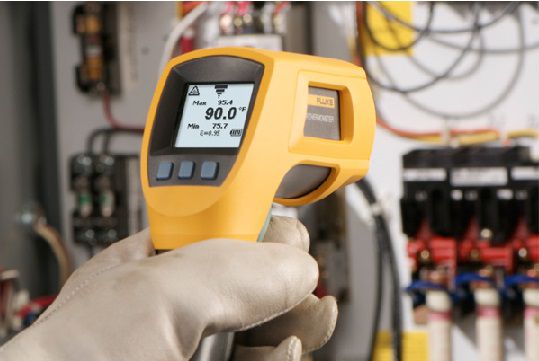
Polished metal surfaces—such as stainless steel, aluminum, or chrome—have very low emissivity, typically ranging from 0.05 to 0.30. When emissivity is difficult to determine, experienced technicians often apply a strip of black tape or coat the surface with matte paint. This creates a known emissivity condition, allowing the default 0.95 setting to produce more reliable results.
3. Installation-Induced Errors: Contact Points and Heat Loss
For contact-based sensors such as RTDs or thermocouples, measurement error often originates at the final point of contact. Even a slight misalignment—just a few millimeters away from the thermal core—or insufficient contact pressure can introduce an insulating air layer, significantly reducing the measured value.
In industrial environments, heat conduction along the probe itself is frequently overlooked. When the sensor body is exposed to a cooler ambient environment, it can draw heat away from the sensing tip, causing consistently lower readings than the actual temperature. In such cases, sensor placement and immersion depth become critical factors.
4. The Consequences of Cumulative Error
Temperature measurement errors are not just numerical discrepancies—they represent hidden financial losses.
Underrange readings: If the system reads lower than the actual temperature, cooling mechanisms may fail to activate in time, leading to overheating and reduced component lifespan.
Overrange readings: Conversely, positive errors can cause the system to overcompensate, wasting energy and increasing operating expenses (OPEX).
Conclusion: To achieve accurate measurement results to temperature meter, engineers need to establish a proper measurement process. Reliable temperature measurement must be the intersection of:
Achieving accurate temperature measurements requires more than precise instruments—it demands a well-structured measurement process. A reliable result lies at the intersection of:
1. Choosing the right measurement principle: Infrared for moving objects; contact methods for maximum accuracy.
2. Controlling the context: Understanding emissivity and material properties.
3. Optimizing sensor placement: Ensuring proper contact at the thermal core while minimizing conductive heat loss along the probe.